Beacon Lighting Supply | Lighting the Way
Understanding IK Ratings: Impact Resistance in Commercial Lighting
When selecting commercial LED lighting fixtures, factors such as lumen output, wattage, color temperature, and energy efficiency are often among the first considerations. However, in demanding commercial and industrial environments, the physical durability of a lighting fixture is equally important.
From warehouses and manufacturing facilities to parking garages, schools, and commercial building exteriors, lighting fixtures can be exposed to accidental impacts, flying debris, equipment collisions, and vandalism.
This is where IK ratings come into play.
Understanding IK ratings can help contractors, facility managers, property owners, and electrical professionals select impact-resistant lighting fixtures that withstand challenging environments, reduce maintenance expenses, and support long-term lighting reliability.
In this guide, we'll explain what IK ratings mean, how they differ from IP ratings, and how to choose the appropriate level of impact resistance for your commercial lighting application.
What Is an IK Rating in Lighting?
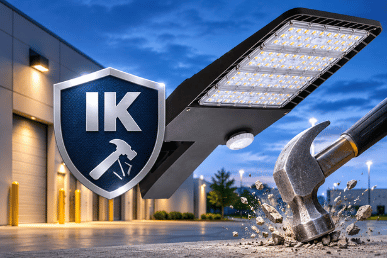
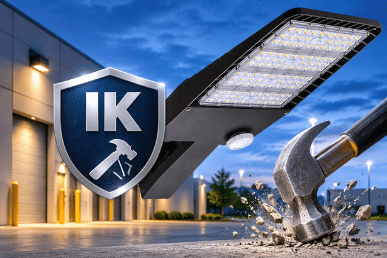
An IK rating is an internationally standardized classification that indicates the level of protection an electrical enclosure provides against external mechanical impacts.
Established under the IEC 62262 standard, the IK rating system measures impact energy in joules (J). Higher ratings represent greater resistance to mechanical impacts under standardized testing conditions.
For commercial LED lighting fixtures, an IK rating helps determine how effectively the fixture's enclosure can withstand physical impacts that could otherwise damage its housing, lens, or internal electrical components.
Unlike specifications such as wattage and lumen output, IK ratings focus on the physical protection of the fixture rather than its lighting performance.
Impact-resistant LED lighting is particularly valuable in environments where fixtures are exposed to equipment, frequent pedestrian activity, accidental contact, or intentional damage.
Understanding the IK Rating Scale
The IK rating scale ranges from IK00 to IK11. While many commercial lighting fixtures are rated between IK07 and IK10, IK11 represents an additional protection level introduced through a 2021 amendment to IEC 62262.
Each classification corresponds to a specific amount of mechanical impact energy.
|
IK Rating |
Impact Energy |
Relative Protection |
|---|---|---|
|
IK00 |
None specified |
No rated protection |
|
IK01 |
0.14 J |
Minimal |
|
IK02 |
0.20 J |
Minimal |
|
IK03 |
0.35 J |
Very low |
|
IK04 |
0.50 J |
Low |
|
IK05 |
0.70 J |
Low |
|
IK06 |
1 J |
Light |
|
IK07 |
2 J |
Moderate |
|
IK08 |
5 J |
Enhanced |
|
IK09 |
10 J |
High |
|
IK10 |
20 J |
Very high |
|
IK11 |
50 J |
Extreme |
Impact energy values are based on IEC 62262, including its 2021 amendment.
Although higher IK ratings provide greater tested impact resistance, not every commercial lighting application requires the highest available classification.
The appropriate rating depends on the installation environment, mounting location, and likelihood of physical damage.
How Are IK Ratings Tested?
IK ratings are determined through controlled mechanical impact testing.
During testing, a fixture's enclosure is subjected to impacts using standardized equipment, such as pendulum hammers, spring hammers, or free-fall hammers, depending on the required classification.
The testing process evaluates how the enclosure responds to a predetermined amount of impact energy.
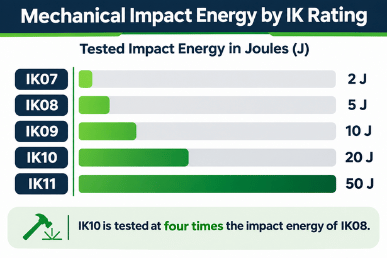
For example, an IK08-rated enclosure is tested at 5 joules, while an IK10-rated enclosure is tested at 20 joules.
This standardized approach allows lighting professionals to compare the impact resistance of fixtures from different manufacturers more effectively.
However, an IK rating does not mean a fixture is indestructible. Cosmetic damage may still occur, and impacts exceeding the tested energy level can compromise the fixture.
IK07 vs. IK08 vs. IK09 vs. IK10 Lighting
Although the IK rating system includes several protection levels, IK07 through IK10 are particularly relevant when comparing commercial and industrial LED lighting fixtures.
IK07 Lighting Fixtures
IK07-rated fixtures provide protection against mechanical impacts of up to 2 joules under standardized testing conditions.
This level may be appropriate for relatively protected commercial environments, such as office corridors, utility rooms, and indoor spaces where accidental contact is possible but significant impacts are unlikely.
IK08 Lighting Fixtures
IK08-rated lighting fixtures provide protection against 5 joules of impact energy.
This classification can offer a practical balance between durability and cost for many commercial lighting projects, including covered walkways, parking structures, warehouses, and commercial building exteriors.
IK09 Lighting Fixtures
IK09-rated fixtures provide protection against 10 joules of impact energy, twice the tested impact energy of IK08.
This increased resistance can be beneficial in industrial facilities, busy public spaces, and commercial environments where fixtures face an increased risk of physical damage.
IK10 Lighting Fixtures
IK10-rated LED fixtures provide protection against 20 joules of impact energy.
These fixtures are particularly useful in demanding environments where accidental impacts or vandalism are significant concerns.
Common applications include transportation facilities, industrial workspaces, public restrooms, parking garages, and recreational facilities.
While IK10 lighting is frequently associated with vandal-resistant lighting, additional features such as tamper-resistant hardware and reinforced housings should also be considered.
IK Ratings vs. IP Ratings: What's the Difference?
IK and IP ratings are often listed together on commercial lighting specification sheets. However, they measure two different types of protection.
An IP rating, or Ingress Protection rating, describes how effectively an enclosure prevents the entry of solid particles and water.
An IK rating describes how effectively an enclosure withstands external mechanical impacts.
|
Feature |
IP Rating |
IK Rating |
|---|---|---|
|
Primary purpose |
Ingress protection |
Impact resistance |
|
Protects against |
Dust, solid objects, and water |
External mechanical impacts |
|
International standard |
IEC 60529 |
IEC 62262 |
|
Common lighting ratings |
IP65, IP66, IP67 |
IK07, IK08, IK09, IK10 |
|
Example application |
Outdoor weather exposure |
Accidental contact or vandalism |
For example, a commercial LED fixture rated IP65 and IK10 offers dust-tight construction, protection against water jets under specified testing conditions, and a tested mechanical impact resistance of 20 joules.
A high IP rating does not automatically indicate a high IK rating, making it important to evaluate both classifications independently.
To learn more about environmental protection in commercial lighting, read our guide: IP Ratings Explained: What IP65, IP66, and IP67 Mean for Lighting.
Where Is Impact-Resistant LED Lighting Used?
Impact-resistant lighting fixtures are beneficial across a wide range of commercial, industrial, and public environments.
Warehouses and Distribution Centers
Warehouses are busy environments where lighting fixtures may be exposed to moving equipment, inventory handling, maintenance activities, and accidental contact.
Durable LED high bay lights and vapor tight fixtures can help minimize damage-related maintenance and interruptions to daily operations.
Impact resistance is especially important for lower-mounted fixtures near loading docks, storage racks, and equipment staging areas.
Parking Garages
Parking garages require reliable illumination to support vehicle navigation, pedestrian visibility, and property security.
Because fixtures may be installed at relatively low mounting heights, they can be vulnerable to accidental contact and vandalism.
Impact-resistant LED canopy lights and enclosed linear fixtures may provide additional durability in these environments.
Commercial Building Exteriors
Outdoor lighting fixtures are exposed to more than rain and dust. Building-mounted fixtures may also encounter debris, maintenance equipment, and intentional damage.
Commercial LED wall packs with durable housings and appropriately rated lenses can be beneficial around building entrances, alleys, loading areas, and pedestrian walkways.
Explore our commercial wall pack lighting guide to learn more about selecting exterior fixtures.
Schools and Recreational Facilities
Schools, gymnasiums, and recreational centers frequently experience high levels of activity.
Lighting fixtures may be exposed to sports equipment, accidental impacts, and frequent contact, making impact resistance an important consideration.
For sports facilities, verify any required ball-impact resistance certification separately, as an IK rating alone does not establish suitability for every athletic application.
Manufacturing and Industrial Facilities
Industrial environments often expose lighting equipment to demanding operating conditions, including machinery, debris, and frequent maintenance.
Selecting appropriately rated industrial LED lighting can help protect fixtures from mechanical damage and reduce costly replacements.
Depending on the facility, additional certifications may be required for hazardous locations, chemical exposure, or extreme operating temperatures.
Benefits of Impact-Resistant Commercial LED Lighting
Reduced Maintenance Costs
Durable lighting fixtures can reduce the frequency of replacements caused by cracked lenses, damaged housings, and accidental impacts.
This can help lower material, labor, and equipment rental expenses.
Improved Workplace Safety
Damaged lighting fixtures can contribute to inadequate illumination, falling fragments, and potential electrical hazards.
Selecting appropriately rated fixtures can help minimize these risks and support a safer working environment.
Increased Operational Reliability
Unexpected lighting failures can interrupt production, warehouse operations, and other commercial activities.
Impact-resistant fixtures can help maintain dependable illumination in demanding environments.
Lower Long-Term Ownership Costs
Although higher-rated fixtures may have a greater initial purchase price, fewer damage-related replacements and maintenance requirements can contribute to lower overall ownership costs.
How to Choose the Right IK-Rated Lighting Fixture
When specifying commercial LED lighting, consider the following factors alongside the fixture's impact resistance rating.
Installation environment: Determine whether the fixture will be exposed to machinery, debris, public access, or other potential sources of physical damage.
Mounting height: Fixtures installed closer to ground level may require greater protection than those mounted high above occupied areas.
Housing and lens materials: Look for durable construction, such as die-cast aluminum housings and impact-resistant polycarbonate lenses. Always verify the actual tested IK rating rather than relying on material descriptions alone.
Environmental protection: Confirm that the fixture has the appropriate IP rating and damp- or wet-location listing for its intended application.
Lighting performance: Evaluate lumen output, color temperature, light distribution, energy efficiency, and control compatibility.
Manufacturer specifications: Review the product specification sheet to confirm the IK rating, installation requirements, applicable certifications, and whether the stated rating applies to the entire fixture or only specific components.
An effective commercial lighting system balances physical durability with energy efficiency, visibility, and application-specific requirements.
Frequently Asked Questions About IK Ratings
Is IK10 lighting waterproof?
No. IK10 measures mechanical impact resistance, not water resistance. Check the fixture's IP rating and wet-location listing to determine its suitability for outdoor or wet environments.
Is IK10 better than IK08?
IK10 is tested at four times the impact energy of IK08. However, IK08 may provide sufficient protection for environments with a lower risk of physical damage.
Does an IK rating mean a fixture is vandal-proof?
No lighting fixture is completely vandal-proof. A high IK rating helps indicate resistance to mechanical impacts, but tamper-resistant hardware, fixture placement, and enclosure design are also important.
Do all LED lighting fixtures have IK ratings?
No. Not every lighting manufacturer publishes an IK rating for every product. If impact resistance is critical to your project, request documentation confirming the required protection level.
Shop Durable Commercial LED Lighting at Beacon Lighting Supply
Choosing the right lighting fixture involves more than selecting the appropriate brightness and wattage. Understanding IK ratings allows contractors, facility managers, and property owners to make more informed decisions when selecting lighting for demanding environments.
At Beacon Lighting Supply, we offer commercial and industrial LED lighting solutions for warehouses, manufacturing facilities, parking garages, commercial building exteriors, and other challenging applications.
Whether you're looking for LED high bay lights, vapor-tight fixtures, commercial wall packs, or outdoor canopy lighting, our team can help you identify products that meet your project's specific requirements.
Explore our selection of commercial and industrial LED lighting fixtures or contact Beacon Lighting Supply for product assistance and project pricing.
Investing in the right lighting fixture means investing in durability, reliability, and long-term performance.