Beacon Lighting Supply | Lighting the Way
IP Ratings Explained: What IP65, IP66, and IP67 Mean for Lighting
When selecting lighting for commercial, industrial, or outdoor applications, understanding IP ratings is essential. Whether you're installing LED wall packs on a commercial building, upgrading warehouse lighting, or choosing fixtures for an outdoor parking lot, the right IP rating can make a significant difference in performance, durability, and long-term maintenance costs.
But what exactly do IP65, IP66, and IP67 mean? And how do you determine which level of protection your lighting application requires?
IP ratings measure how effectively electrical enclosures resist the intrusion of dust, dirt, and water. For LED lighting fixtures, these ratings help contractors, property managers, and facility owners select products that can withstand specific environmental conditions.
In this guide, we'll explain the differences between IP65, IP66, and IP67 lighting, discuss common commercial applications, and help you choose the appropriate protection level for your next lighting project.
What Is an IP Rating in Lighting?
An IP rating, short for Ingress Protection rating, is an internationally recognized classification system established by the International Electrotechnical Commission (IEC) under standard IEC 60529.
The rating identifies how effectively an electrical enclosure protects against the entry of solid objects and water.
IP ratings consist of two numbers:
-
First digit: Indicates protection against solid objects, including dust and debris.
-
Second digit: Indicates protection against water intrusion.
For example, an IP65 LED light fixture has a dust protection rating of 6 and a water protection rating of 5.
The first digit ranges from 0 to 6, while the second digit ranges from 0 to 9. Higher ratings generally indicate greater protection within their respective categories, although different water tests are not always directly interchangeable.
Understanding these numbers is particularly important when purchasing commercial LED lighting for demanding environments such as warehouses, parking garages, manufacturing facilities, and outdoor commercial properties.
IP65 vs. IP66 vs. IP67: What's the Difference?
Although these three ratings look similar, each represents a different level or type of water protection.
|
IP rating |
Dust protection |
Water protection |
Common lighting applications |
|---|---|---|---|
|
IP65 |
Dust-tight |
Water jets |
Outdoor wall packs, floodlights, canopy lights |
|
IP66 |
Dust-tight |
Powerful water jets |
Exposed industrial fixtures, washdown areas |
|
IP67 |
Dust-tight |
Temporary immersion in water |
Certain landscape fixtures, in-ground lights, flood-prone installations |
All three ratings provide the same dust-tight protection. The primary difference is how each fixture is tested against water exposure.
Let's examine each rating more closely.
What Does IP65 Mean for LED Lighting?
IP65 lighting fixtures are dust-tight and protected against water jets from any direction.
This makes IP65 one of the most commonly specified protection levels for outdoor commercial LED lighting.
An IP65-rated fixture is designed to prevent dust from entering the enclosure and resist water intrusion under defined jet-testing conditions.
Common Applications for IP65 Lighting
IP65-rated LED fixtures are frequently suitable for:
-
Commercial building exteriors
-
Outdoor LED wall pack lighting
-
Parking lot perimeter lighting
-
Building-mounted security floodlights
-
Covered and exposed loading areas
-
Certain canopy and warehouse applications
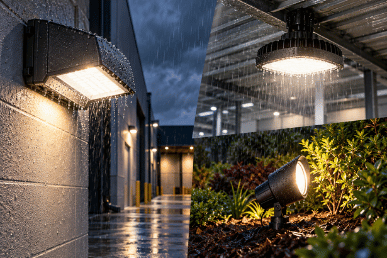
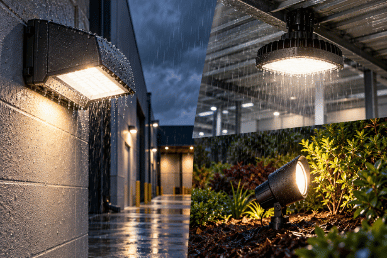
For example, LED wall packs installed on the exterior of a retail building may experience rain, airborne dust, and occasional water spray. An appropriately designed IP65 fixture can provide protection against these environmental conditions.
However, IP65 does not mean a fixture can be submerged in water or withstand every type of high-pressure cleaning.
When selecting outdoor lighting, contractors should also verify that the fixture is listed for wet locations and suitable for the intended mounting configuration.
Explore lighting options: Browse our commercial and outdoor LED lighting products at Beacon Lighting Supply.
What Does IP66 Mean for LED Lighting?
IP66 lighting fixtures are dust-tight and protected against powerful water jets.
While IP65 and IP66 offer identical dust protection, IP66 fixtures undergo a more demanding water-jet test.
This additional protection can be valuable in industrial and commercial environments where lighting equipment is exposed to forceful water spray.
Common Applications for IP66 Lighting
IP66-rated fixtures may be appropriate for:
-
Industrial manufacturing facilities
-
Outdoor loading docks
-
Agricultural buildings
-
Wastewater treatment facilities
-
Industrial washdown areas
-
Exposed commercial building exteriors
-
Certain food-processing environments
Consider an industrial facility where equipment and surrounding surfaces are routinely cleaned with water hoses.
An IP66-rated fixture provides greater protection against powerful water jets than an IP65-rated fixture. However, specialized high-pressure or high-temperature sanitation processes may require additional ratings beyond IP66.
For contractors and facility managers, choosing lighting with the appropriate IP rating can help reduce moisture-related failures, minimize maintenance requirements, and improve long-term reliability.
Shop commercial lighting: Explore LED lighting solutions for industrial and commercial facilities.
What Does IP67 Mean for LED Lighting?
IP67 lighting fixtures are dust-tight and protected against the effects of temporary water immersion.
Under standard IP67 test conditions, an enclosure must resist harmful water ingress during temporary immersion, commonly described as immersion up to approximately one meter for 30 minutes.
This makes IP67 particularly relevant for lighting applications where temporary submersion is possible.
Common Applications for IP67 Lighting
IP67-rated lighting may be suitable for:
-
Certain in-ground landscape lights
-
Ground-level architectural lighting
-
Outdoor installations subject to temporary flooding
-
Selected low-voltage landscape lighting systems
-
Certain industrial environments with temporary immersion risks
For example, landscape lighting installed near drainage areas may occasionally encounter standing water after heavy rainfall.
An appropriately designed IP67 fixture can provide additional protection against temporary immersion compared with a fixture rated only for water jets.
However, IP67 should not be confused with protection against continuous underwater operation.
For fountains, ponds, swimming pools, or permanently submerged lighting applications, fixtures specifically designed and listed for those installations are required.
Is IP67 Better Than IP66?
Not necessarily.
One of the most common misconceptions about IP ratings is that a higher second digit automatically means a fixture provides every type of protection covered by lower ratings.
IP66 and IP67 actually address different water exposure conditions.
IP66 focuses on powerful water jets, while IP67 focuses on temporary immersion.
An IP67 rating alone does not necessarily establish that a fixture has passed the IP66 powerful water-jet test.
If an installation requires both types of protection, look for products with documented dual ratings, such as IP66/IP67.
How to Choose the Right IP Rating for Your Lighting Application
Choosing the correct IP rating requires evaluating the actual environmental conditions surrounding your lighting installation.
While a higher rating may appear more desirable, selecting a fixture based on its intended application is generally more important than purchasing the highest-rated product available.
1. Evaluate Water Exposure
Determine whether your lighting fixtures will experience occasional rain, direct water spray, powerful cleaning jets, or possible submersion.
For typical outdoor commercial applications, IP65 may provide sufficient protection. Industrial facilities exposed to stronger water jets may benefit from IP66, while temporary immersion risks may justify IP67.
2. Consider Dust and Debris
Warehouses, manufacturing plants, agricultural buildings, and construction-related environments can contain substantial airborne dust.
Dust-tight fixtures help protect internal electrical components from contamination, making IP65, IP66, and IP67 valuable options for dusty environments.
3. Check the Fixture's Installation Requirements
Even a highly rated LED fixture can experience problems when improperly installed.
Contractors should verify:
-
Approved mounting positions
-
Properly sealed electrical connections
-
Compatible conduit fittings and cable glands
-
Manufacturer installation instructions
-
Appropriate environmental and safety listings
An IP rating applies to a specified enclosure configuration. Improper installation or modifications may compromise its protection.
4. Consider Additional Environmental Factors
IP ratings do not measure every aspect of fixture durability.
For commercial and industrial LED lighting, also evaluate corrosion resistance, operating temperature, UV exposure, impact resistance, and applicable NEMA enclosure classifications.
For example, coastal installations may require corrosion-resistant materials even when a fixture has a high IP rating.
Does an IP Rating Mean a Light Fixture Is Waterproof?
The terms waterproof and water-resistant are frequently used interchangeably in lighting product descriptions, but they are not always technically equivalent.
An IP65-rated fixture can resist water jets under specified conditions, but it is not necessarily suitable for immersion.
Similarly, IP67 protection does not mean a fixture can remain underwater indefinitely.
When purchasing waterproof outdoor LED lights, always examine the manufacturer's technical specifications rather than relying exclusively on marketing descriptions.
Shop Outdoor and Industrial LED Lighting at Beacon Lighting Supply
At Beacon Lighting Supply, we offer commercial and industrial lighting solutions for contractors, facility managers, property owners, and businesses nationwide.
Explore some of our outdoor lighting options:

A wet-location-rated commercial exterior fixture designed for applications such as loading docks, building perimeters, and parking areas.

A wet-location-rated landscape lighting option for commercial exterior applications.

Westgate Spec Series LED Bullet Flood Light
An outdoor landscape floodlight option for projects requiring directional accent illumination.
Product note: These are verified listings on Beacon Lighting Supply's website, but their published pages do not establish specific IP65, IP66, or IP67 ratings. Confirm the exact manufacturer's IP rating before ordering for an application requiring one.
Frequently Asked Questions About Lighting IP Ratings
Is IP65 good enough for outdoor lighting?
Yes, IP65 is commonly suitable for outdoor LED lighting exposed to rain, dust, and water jets. However, fixture suitability also depends on wet-location listings, installation conditions, and manufacturer specifications.
Can IP66 lights be used in heavy rain?
Yes. IP66-rated enclosures provide protection against powerful water jets, making them suitable for many exposed outdoor environments when the complete fixture is approved for the installation.
Can IP67 lights be permanently submerged?
No. IP67 addresses temporary immersion. Permanent underwater applications require lighting specifically designed and approved for continuous submersion and the intended installation environment.
What IP rating is best for commercial lighting?
There is no single best rating. IP65 is often sufficient for general outdoor applications, IP66 may be preferable for powerful water-jet exposure, and IP67 is appropriate when temporary immersion is a concern.
Final Thoughts: Choosing Between IP65, IP66, and IP67
Understanding IP ratings is an important part of selecting reliable commercial and industrial LED lighting.
IP65 offers dust-tight protection and resistance to water jets, making it a common choice for exterior building lighting. IP66 provides additional protection against powerful water jets, while IP67 addresses temporary water immersion.
The best choice ultimately depends on your installation environment, exposure conditions, and manufacturer requirements.
At Beacon Lighting Supply, we're committed to helping contractors, commercial property owners, and facility managers find dependable, energy-efficient lighting solutions for their projects.
Whether you're upgrading exterior wall packs, installing industrial lighting, or planning a commercial outdoor lighting system, selecting fixtures with appropriate environmental protection can help improve reliability and reduce maintenance over time.
Explore our outdoor commercial LED lighting selection and find the right solution for your next project.