
Beacon Lighting Supply | Lighting the Way
A fluorescent troffer that keeps eating ballasts is usually not a lamp problem. It is a maintenance problem, a labor problem, and eventually a budget problem. That is why Type B LED tubes come up so often in retrofit conversations - they remove the ballast from the equation and give contractors, facility teams, and property managers a more direct path to long-term reliability.
What Type B LED tubes are
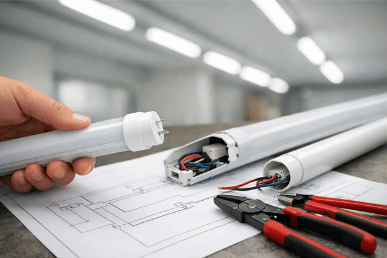
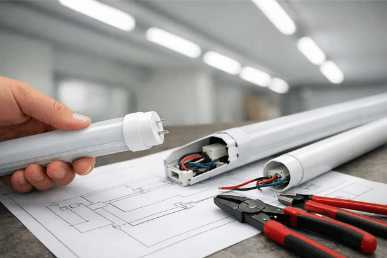
Type B LED tubes are ballast-bypass lamps. Instead of running through the existing fluorescent ballast, they operate on direct line voltage after the fixture is rewired. In a typical retrofit, the ballast is disconnected or removed, power is routed to the lamp holders according to the tube manufacturer’s wiring diagram, and the fixture is relabeled to indicate it now accepts only the specified LED lamp type.
That basic change matters more than it sounds. In fluorescent systems, the ballast is often the first component to fail. When you bypass it, you eliminate a common service point and reduce the chance that a future lamp replacement turns into a ballast troubleshooting call.
Why Type B LED tubes are popular in retrofit work
For many commercial buildings, schools, offices, storage areas, and back-of-house spaces, the appeal is straightforward. Type B LED tubes can lower energy use, simplify maintenance, and improve consistency across a large installed base of linear fixtures.
The biggest advantage is ballast independence. If your site has aging fluorescent fixtures with mixed ballast conditions, ballast-compatible LED tubes may only postpone the next service issue. A ballast-bypass setup avoids compatibility lists, avoids ballast failures, and often makes future lamp replacements simpler because there is one less component in play.
There is also a practical inventory benefit. Maintenance teams dealing with multiple fluorescent lamp and ballast combinations often want to standardize. Once fixtures are properly converted, Type B LED tubes can help reduce the number of replacement parts that need to be stocked.
That said, the labor profile shifts. These lamps are not always the fastest option on day one because rewiring takes time and should be done correctly by qualified personnel. The payoff tends to show up later through lower maintenance and fewer ballast-related callbacks.
Type A vs. Type B LED tubes
If you are choosing between retrofit approaches, the decision usually comes down to speed now versus simplicity later. Type A LED tubes use the existing ballast. They are often easier to install initially, especially when the ballast is in good condition and the compatibility is confirmed. But they still depend on that ballast to operate.
Type B LED tubes require fixture modification, so installation is more involved. In exchange, you remove ballast compatibility concerns and one of the most failure-prone components in the fixture. For facilities with high maintenance costs, hard-to-access ceilings, or a large number of older fixtures, that trade-off can be worth it.
There is also a middle ground in some projects with hybrid lamps, often called Type A/B, but those are not automatically the best answer. If your long-term goal is ballast elimination, a dedicated Type B retrofit is usually the cleaner path.
Single-ended and double-ended Type B LED tubes
This is where selection gets technical, and where ordering mistakes happen.
Type B LED tubes are generally wired in one of two ways: single-ended power or double-ended power. Single-ended lamps receive line and neutral on the same end of the tube. Double-ended lamps receive line on one end and neutral on the other. The lamp holders and wiring layout must match the lamp design exactly.
Neither format is universally better. Single-ended products can simplify some fixture layouts, but they require careful attention to lamp holder condition and correct socket assignment. Double-ended products may feel more familiar to installers because power is distributed across both ends, but fixture design still matters. The right choice depends on the specific fixture, the approved lamp configuration, and the installation crew’s familiarity with that wiring method.
This is not an area for assumptions. Product cut sheets and wiring diagrams should drive the job, especially across multi-fixture projects where consistency is critical.
Where Type B LED tubes make the most sense
These lamps are often a strong fit in buildings with older fluorescent infrastructure and recurring ballast issues. Think offices with 2x4 troffers, utility corridors, retail back rooms, schools, maintenance areas, and warehouses using linear strip fixtures.
They also make sense in properties where access is expensive. If replacing a failed ballast means bringing in a lift, opening occupied spaces after hours, or dispatching maintenance staff repeatedly across multiple buildings, the higher upfront labor of a ballast-bypass retrofit can make financial sense.
In contrast, Type B LED tubes may be less attractive for facilities that want the quickest possible install with minimal fixture modification, or where local policies strongly favor complete fixture replacement over lamp retrofits. In some cases, replacing the fixture with a new integrated LED troffer or strip can deliver better optics, controls compatibility, and a longer-term modernization path.
Safety and code considerations matter
A Type B retrofit changes how the fixture is powered, so safety is not a footnote. Power must be disconnected before work begins, the ballast must be properly bypassed, and the fixture should be relabeled after conversion. The installed lamp must match the rewired configuration.
This matters for the next person servicing the fixture too. A relabeled ballast-bypass fixture tells future maintenance staff that the fixture no longer operates like a fluorescent system. That helps prevent incorrect lamp replacements and unsafe assumptions during troubleshooting.
Lamp holder condition is another issue that gets overlooked. If the tombstones are brittle, loose, or not rated for the required wiring method, they should be replaced as part of the retrofit. Saving a few dollars on sockets can create expensive failures later.
For commercial projects, it is also smart to review local code requirements, internal maintenance standards, and any utility rebate conditions before moving forward. Some programs have specific documentation or product qualification requirements.
Buying Type B LED tubes without creating project headaches
Spec sheets matter here more than marketing claims. Start with the basics: lamp length, wattage, lumen output, color temperature, base type, and whether the lamp is single-ended or double-ended. Then confirm the operating voltage, enclosed-fixture rating if needed, and any restrictions on dimming or controls.
Color selection should match the application, not just the old fluorescent lamp. A 3500K or 4000K tube is common in offices and commercial interiors, while 5000K may be preferred in task-oriented, warehouse, or utility spaces. If appearance and consistency matter across a property, standardize the color temperature before ordering in bulk.
Lumen levels deserve the same discipline. More output is not always better. Over-lighting can create glare, waste energy, and make a retrofit feel harsher than the original space. If the fixture has a lens, reflector, or parabolic design, actual delivered light can vary enough that mockups are worth considering on larger jobs.
Warranty and product quality should also carry weight. In low-cost retrofit products, inconsistency between batches, premature driver failure, and weak socket engagement are all real risks. For project buyers, a dependable supply partner matters as much as the lamp itself because reorder consistency, technical support, and warranty response affect the total cost of ownership.
When a full fixture replacement may be the better choice
Not every fluorescent fixture should be retrofitted. If the housing is damaged, the optics are dated, the fixture layout no longer suits the space, or you need integrated controls, it may be more practical to replace the whole fixture.
That is especially true in higher-visibility areas where appearance matters, or in projects where labor is already allocated for ceiling work. A new LED fixture can improve efficiency and reduce maintenance while also delivering better distribution, cleaner aesthetics, and easier controls integration.
Still, for many property portfolios, Type B LED tubes hit the right balance. They allow a staged upgrade strategy, preserve usable fixture housings, and address one of the most common fluorescent failure points without forcing a full replacement across every room at once.
A practical way to plan a Type B LED tubes retrofit
If you are evaluating a rollout, start with a small sample area rather than a building-wide order. Verify the fixture types on site, inspect lamp holders, identify the preferred wiring method, and test light levels and color in the actual space. That early validation can prevent mismatched product, labor overruns, and avoidable returns.
For larger facilities or multi-site work, standardization pays off quickly. Build around a limited set of approved lamps and fixture configurations, document the rewiring approach, and make sure replacement purchasing follows the same specification. That is where working with a supplier that can support both product selection and volume pricing becomes useful. Beacon Lighting Supply can help buyers source premium retrofit options and simplify larger procurement needs with specialist support.
The best retrofit is not the one with the lowest lamp cost. It is the one that reduces failures, fits the fixture correctly, and holds up under real maintenance conditions long after the installation crew leaves the site.