Beacon Lighting Supply | Lighting the Way
A failed parking lot lamp, dim warehouse aisle, or color-shifted gym fixture usually creates the same problem - someone needs a reliable answer fast. Metal halide bulb replacement is often treated like a simple lamp swap, but in commercial and industrial settings, the right choice affects light levels, ballast compatibility, maintenance cycles, and operating cost.
When metal halide bulb replacement is the right move
Metal halide lamps have been used for years in high bays, flood lights, wall packs, shoebox fixtures, and other HID applications because they produce strong output for large spaces. Many facilities still rely on them, especially in older installations where the fixture housing remains serviceable and a full fixture changeout is not yet in the budget.
In those cases, replacing the lamp can be the practical short-term fix. If the fixture body is intact, the ballast is functioning correctly, and the application does not require an immediate energy retrofit, a like-for-like replacement may keep operations moving without major disruption.
That said, metal halide systems do not age gracefully. Output declines over time, restrike can become inconsistent, and color can shift noticeably before complete failure. If your maintenance team is replacing lamps frequently or dealing with uneven lighting across a facility, the issue may be broader than a single burned-out bulb.
Start with fixture and lamp compatibility
Before ordering anything, verify the existing lamp specifications. This step matters more than many buyers expect because HID systems are less forgiving than standard screw-base lamp replacements.
Check the lamp wattage, base type, bulb shape, operating position, and ANSI code if available. A 400W metal halide lamp is not automatically interchangeable with every 400W fixture. Ballast matching is critical, and incorrect pairing can lead to poor performance, shortened lamp life, or startup failure.
Operating position is another detail that gets overlooked. Some lamps are rated for base-up, base-down, or horizontal operation only. In high bays, flood fixtures, and area lighting, using the wrong orientation-rated lamp can reduce performance and create premature failure issues.
If the existing label inside the fixture is faded or missing, use the old lamp markings and ballast information to confirm the replacement. For commercial properties managing multiple buildings, standardizing this information across maintenance records can save significant time on future reorders.
Signs the problem is not just the bulb
A lamp that will not start is not always a lamp problem. In older HID systems, the ballast, ignitor, socket, wiring, or accumulated heat damage inside the fixture may be the actual cause.
If a new metal halide lamp cycles on and off, starts slowly, burns dim, or fails again after a short period, inspect the rest of the system. Ballasts degrade over time, and aging components can make a fresh lamp look defective when the real issue is electrical.
This is where a simple replacement can turn into wasted maintenance labor. For facilities managers and contractors, it is usually more cost-effective to diagnose the full fixture condition up front than to send crews back repeatedly for the same outage.
Safety comes first with HID lamp service
Metal halide lamp replacement should be handled with the same caution given to other high-output electrical components. Turn power off, allow the fixture and lamp to cool fully, and inspect for visible damage before touching the socket or internal components.
These lamps operate at high temperatures and pressures. If a lamp shows swelling, cracking, darkening near the arc tube, or signs of arcing at the base, replace it carefully and inspect the fixture for related damage. In enclosed fixtures, always confirm that the replacement lamp is approved for that use.
For elevated applications such as warehouse ceilings, exterior poles, and canopy fixtures, access planning matters just as much as the lamp itself. The real cost of replacement often includes lift time, labor coordination, and site disruption. That is one reason many property teams use lamp failure as the trigger to evaluate LED conversion rather than continuing repeated HID maintenance.
Like-for-like replacement vs LED retrofit
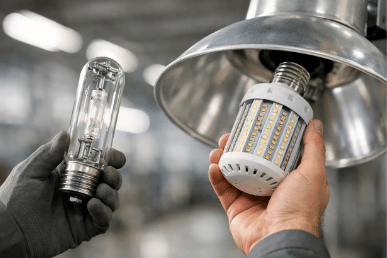
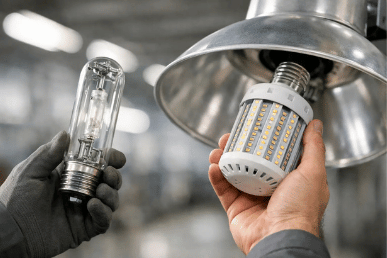
This is usually the key decision. A direct metal halide bulb replacement makes sense when you need immediate continuity in an existing HID system and the fixture platform is still worth maintaining. It can also be the right option for short-term ownership horizons, limited budgets, or sites where a broader retrofit is planned later.
But if the goal is lower operating cost and fewer service calls, LED often makes better business sense. LED replacements and retrofit solutions can reduce energy use, improve uniformity, deliver faster startup, and eliminate many of the performance issues tied to aging HID lamps and ballasts.
The trade-off is compatibility and scope. Some LED replacements are ballast-compatible, some require ballast bypass, and some applications are better served by replacing the complete fixture instead of retrofitting the lamp alone. In outdoor or industrial environments, thermal management, enclosure rating, and fixture condition should all factor into that decision.
For procurement teams managing multiple sites, the best answer is not always one-size-fits-all. A warehouse with durable high bay housings may be a strong retrofit candidate, while an older exterior area light with corrosion or failing optics may justify full fixture replacement.
Choosing the right replacement for commercial use
In practical terms, buyers should focus on application first, not just wattage. A lamp for a gymnasium, parking lot, fabrication area, or retail exterior may share a general category but perform differently based on beam control, burn position, and fixture design.
For like-for-like metal halide replacements, verify rated life, lumen output, color temperature, and startup characteristics. Premium-quality lamps can help reduce maintenance frequency and support more consistent lighting across a property, which matters in customer-facing areas and safety-sensitive work zones.
If you are evaluating LED alternatives, compare actual delivered light rather than assuming a watt-for-watt equivalent. LED products often use far less wattage to achieve similar or better usable illumination, but the fixture and application determine results. Glare, distribution, and mounting height all affect performance.
This is where a supply partner with application knowledge adds value. Instead of sorting through fragmented product listings, buyers can match replacements to ballast type, fixture form factor, and site conditions with fewer ordering errors.
Common applications where replacement decisions matter most
High-burn commercial environments feel the impact of HID maintenance fastest. Warehouses, manufacturing facilities, school gyms, parking lots, sports lighting areas, and large retail exteriors all depend on reliable output and quick sourcing when failures occur.
In these settings, one failed lamp is rarely just one failed lamp. It can indicate the start of a broader maintenance cycle across lamps installed at the same time. If multiple fixtures are dimming or dropping out in the same area, group relamping or a planned LED conversion may be more efficient than one-off replacements.
Property managers should also consider how outages affect safety and appearance. Exterior lighting with inconsistent color or failed fixtures can create liability concerns, while interior production areas may face visibility issues that affect workflow.
Procurement considerations for bulk orders
For contractors and facility teams ordering at scale, consistency matters as much as price. Mixing lamp brands, color temperatures, or performance tiers across a site can produce uneven results and create avoidable callbacks.
Bulk purchasing should start with a verified fixture schedule or lamp matrix. Once the installed base is documented, ordering becomes faster, substitutions are easier to evaluate, and future maintenance planning is more predictable. Volume discounting can also improve project economics, especially when paired with support on cross-referencing legacy lamps or identifying retrofit paths.
Beacon Lighting Supply supports both one-off replacement needs and larger project procurement, which is especially useful when a simple reorder turns into a broader lighting upgrade discussion.
When to stop replacing metal halide lamps
There is a point where continued lamp replacement stops being efficient. If your site is dealing with repeated ballast failures, expensive lift access, long warm-up times, poor light quality, or rising energy costs, the system may be costing more to maintain than it is worth.
That does not mean every metal halide fixture needs to disappear immediately. It means the replacement decision should be made with total operating cost in mind, not just the price of a single lamp. For many facilities, the smartest next step is to confirm what failed, match the right replacement, and decide whether that fixture deserves another lamp or a better long-term solution.
If you are sourcing for a building, campus, or multi-site portfolio, getting the specification right the first time saves more than product cost - it saves labor, downtime, and repeat purchasing headaches later.