Beacon Lighting Supply | Lighting the Way
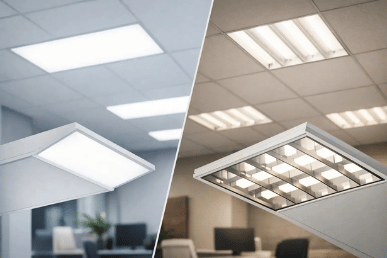
A troffer decision usually gets pushed down the list until lamps start failing, ballasts begin buzzing, or an energy audit forces the issue. That is when the LED vs fluorescent troffers conversation stops being theoretical and becomes a budget, maintenance, and performance question for the building.
For contractors, facility teams, and property managers, the right answer depends less on trends and more on what the space needs to do every day. Offices need consistent visual comfort. Schools and healthcare settings need dependable light quality and low disruption. Commercial buildings with large fixture counts need a clear payback path. Troffers are simple fixtures on paper, but choosing between LED and fluorescent affects labor, controls, stocking, and long-term operating costs.
LED vs fluorescent troffers at a glance
Fluorescent troffers have been a long-standing standard in commercial ceilings because they were efficient compared to older lighting technologies and widely available in common sizes such as 2x2 and 2x4. They are familiar, serviceable, and often already installed in large numbers across offices, corridors, classrooms, and retail back-of-house spaces.
LED troffers were adopted first for energy savings, but that is no longer the only reason buyers switch. Modern LED troffers and LED retrofit kits offer better life expectancy, easier control compatibility, more stable light output, and fewer maintenance points because there are no fluorescent tubes or traditional ballasts to replace on a routine cycle.
If you are making a new fixture choice for a renovation or build-out, LED usually has the stronger long-term case. If you are maintaining an existing fluorescent system under a tight short-term budget, fluorescent may still appear cheaper at the point of purchase, but that is only one part of the cost.
Energy use and operating cost
The biggest reason most facilities compare LED and fluorescent troffers is simple: utility cost. In similar light output ranges, LED troffers generally use less wattage than fluorescent models. Across a handful of fixtures, the difference may look modest. Across a school district, office floor, medical suite, or retail chain, it adds up quickly.
Fluorescent systems also lose efficiency as components age. Lamp output declines over time, and ballast issues can reduce performance before total failure. LED fixtures are not immune to lumen depreciation, but well-made products tend to hold usable light levels more consistently across their rated life.
That said, payback is not identical in every project. If a space runs lights only a few hours a day, the energy savings case takes longer to recover the upgrade cost. In a building with long operating hours, such as call centers, hospitals, municipal buildings, or 24-hour support spaces, LED economics are usually much more compelling.
Maintenance is where LED often pulls ahead
Maintenance is easy to underestimate until you have dozens or hundreds of ceilings to service. Fluorescent troffers require lamp replacement, ballast replacement, and disposal procedures that can complicate routine maintenance. Even if replacement lamps are inexpensive, labor is not.
LED troffers reduce those service intervals. Instead of replacing tubes and chasing ballast failures, many facilities can go years with minimal fixture attention. For buildings with high ceilings, occupied office areas, or hard-to-access spaces, fewer maintenance calls can matter as much as lower wattage.
There is a trade-off worth acknowledging. When a fluorescent component fails, the repair may be simple if the system uses common lamps and ballasts. With some LED fixtures, serviceability depends on fixture design. Integrated LED troffers can mean replacing the fixture or internal driver rather than swapping a lamp. That is why product quality and warranty support matter. A low-cost LED fixture that fails early is not a savings.
Light quality and occupant comfort
This is where older assumptions can lead buyers in the wrong direction. Many people still associate LED with harsh or overly cool light because early products often delivered exactly that. Current commercial LED troffers are available in multiple color temperatures, better diffuser designs, and improved optical control that can produce a more comfortable environment than aging fluorescent systems.
Fluorescent troffers can still provide good general illumination, especially in spaces designed around them. But flicker, slow startup, inconsistent lamp color, and dim lamp ends become common complaints as systems age. In workspaces where visual comfort affects productivity or tenant satisfaction, those issues create more than a maintenance problem.
LED also gives specifiers more flexibility. It is easier to source troffers with selectable color temperature, selectable wattage, or dimming capability. That matters in offices, educational settings, and multipurpose spaces where one fixture type may need to serve different layout plans or user preferences.
Controls and code compliance
If your project includes occupancy sensors, daylight harvesting, or dimming, LED troffers usually offer a cleaner path. Many are built with control compatibility in mind, and integrated options are widely available for commercial applications.
Fluorescent can support controls, but compatibility is more limited and more dependent on ballast type. Retrofitting controls into an older fluorescent layout may be possible, but it often involves more coordination and less flexibility than a comparable LED upgrade.
For renovation projects driven by energy code updates, LED often aligns better with current compliance goals. Exact requirements vary by jurisdiction, building type, and scope of work, so it is important to review the project-specific standard. Still, in practical procurement terms, LED tends to make those conversations easier.
Upfront cost versus total project cost
Fluorescent troffers or replacement fluorescent components may still look cheaper in the short term. For a maintenance department trying to keep a legacy system running until a larger capital project is approved, that can be a valid temporary strategy.
But fixture price alone does not tell the whole story. Total project cost includes energy use, future lamp purchases, ballast replacement, labor, disposal, downtime, and the likelihood of needing another upgrade as fluorescent availability continues to tighten. Some facilities also face standardization problems when they keep part of a building fluorescent and convert the rest to LED.
LED projects can also be approached in more than one way. A full fixture replacement is not always necessary. Depending on the condition of the housing, a retrofit kit may provide a practical middle ground, preserving the ceiling's appearance while upgrading performance. That kind of option matters in occupied buildings where disruption needs to stay low.
Availability and long-term procurement risk
This is one of the less discussed parts of the LED vs fluorescent troffers decision, but it matters for anyone buying at scale. Fluorescent technology is not going away overnight, but the market direction is clear. Lamp and ballast availability has become less predictable as manufacturers shift focus and regulations continue to affect certain fluorescent products.
For procurement teams, that creates risk. A fixture type that is cheap to maintain today can become harder to support over the next few years. If your building portfolio depends on consistent stocking for emergency replacement, standardizing on supported LED platforms may be the more stable long-term move.
This is especially relevant for multi-site properties, school systems, and commercial portfolios that want fewer SKUs, more predictable maintenance planning, and less scrambling when a lamp family gets discontinued.
When fluorescent troffers still make sense
There are cases where sticking with fluorescent for now is reasonable. If the building is nearing a major renovation, if the budget only covers immediate repairs, or if a space has existing inventory and maintenance procedures built around fluorescent systems, a short-term hold strategy may be justified.
The key is to recognize it as a short-term decision, not a long-term optimization plan. If you continue investing in fluorescent, make sure replacement lamps and ballasts are still obtainable, and weigh whether each repair dollar would be better applied toward a phased LED conversion.
When LED troffers are the better call
LED is usually the better fit when you are planning for lower operating costs, fewer service calls, better controls, and a more future-ready commercial lighting package. That applies to office remodels, school retrofits, tenant improvements, healthcare upgrades, and broad maintenance standardization efforts.
It is also the better choice when light quality complaints are already part of the problem. Replacing failed fluorescent components may restore operation, but it will not necessarily improve the workspace. A well-specified LED troffer or retrofit can solve both maintenance and performance issues at the same time.
For larger projects, fixture selection should not stop at LED versus fluorescent. Housing condition, ceiling type, photometric needs, emergency requirements, controls, color temperature, and warranty support all affect the right product choice. That is where working with a supply partner who can help evaluate counts, applications, and volume pricing saves time.
If you are weighing a retrofit or fixture replacement across one room or an entire facility, start by looking beyond the carton price. The better troffer choice is the one that keeps your building easier to maintain, easier to source, and easier to operate over the next several years. If your team needs help sorting through fixture options, retrofit paths, or bulk purchasing, Beacon Lighting Supply can help you narrow the spec before you place the order.