Beacon Lighting Supply | Lighting the Way
A dim warehouse aisle costs more than visibility. It slows picking, creates safety issues around lifts and storage racks, and makes routine work harder than it should be. That is why LED high bay lights have become the standard choice for facilities that need dependable illumination in large spaces with high ceilings.
For contractors, facility managers, and procurement teams, the real question is not whether to move to LED. It is which fixture, optic, output, and mounting approach will actually suit the building. High bay lighting is rarely a one-size-fits-all purchase. Ceiling height, layout, operating hours, ambient temperature, and the nature of the work below the fixture all affect the right specification.
What LED high bay lights are designed to do
LED high bay lights are built for spaces with ceilings typically 15 feet and above, where standard commercial fixtures cannot deliver useful light to the task area efficiently. You will see them in warehouses, manufacturing plants, distribution centers, gymnasiums, retail stockrooms, aircraft hangars, and large assembly spaces.
Their job is straightforward: deliver strong, controlled light from a higher mounting point while minimizing wasted output, glare, and maintenance. Compared with older metal halide or fluorescent high bays, LED models offer more stable performance, faster startup, better color quality, and significantly lower operating costs over time.
That matters in facilities where lights run long shifts or around the clock. Reduced relamping alone can change the maintenance picture, especially in buildings where every fixture service call requires lifts, lane closures, or after-hours labor.
Where the biggest gains come from
The appeal of LED is not just lower wattage. In practice, the value comes from a combination of energy savings, fixture longevity, and better light distribution.
A quality LED high bay can deliver high lumen output with less power than legacy systems, but the more meaningful advantage is usable light on the floor. Many facilities upgrading from older HID fixtures notice fewer dark zones and more consistent visibility between aisles, racks, workstations, and open floor areas. That can support safety, accuracy, and overall working conditions.
Color rendering also deserves attention. In operations where labels, wiring, parts, or product finishes need to be identified correctly, LED often provides a cleaner visual environment than aging legacy lamps. If your team is reading packaging, inspecting components, or moving equipment through narrow areas, visibility quality matters as much as raw brightness.
Choosing the right LED high bay lights
The best fixture depends on application, not just on lumen claims printed on a spec sheet. A warehouse with tall racks has different lighting needs than a gym or fabrication space. Start with the basic conditions in the building.
Ceiling height and fixture output
Higher mounting heights usually require higher lumen packages and tighter optical control. A fixture installed at 18 feet has different performance demands than one mounted at 35 feet. Buying too little output can leave task areas underlit. Buying too much can create glare, wasted energy, and an uncomfortable environment.
As a working rule, lumen needs should be matched to both mounting height and activity below. General storage may tolerate different light levels than detailed assembly, packaging, or maintenance work. That is why layout planning matters as much as individual fixture selection.
Wide distribution vs. focused optics
Open spaces often benefit from broad distribution, while narrow aisle applications may call for optics designed to push light down and along the aisle rather than across rack faces. This is one of the most common specification mistakes in warehouse projects. A high-output fixture with the wrong distribution can still produce poor results.
Facilities with mixed-use zones may need more than one high bay configuration. The receiving area, staging area, and active pick aisles do not always need the same beam pattern or output.
UFO vs. linear high bays
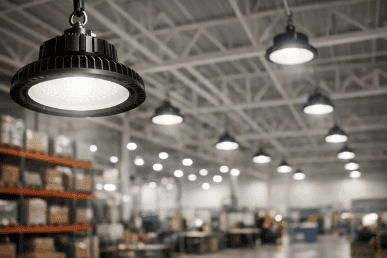
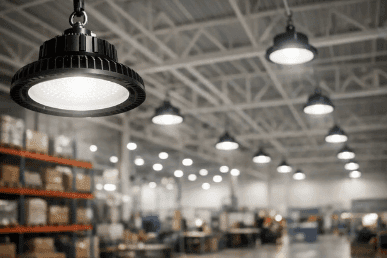
UFO high bays are compact, durable, and common in industrial and warehouse settings. They are often a strong fit for open areas, higher ceilings, and installations where simple mounting and rugged construction are priorities.
Linear high bays can be a better choice when replacing fluorescent strips or when a broader rectangular light pattern better matches the space. They are frequently used in warehouses, retail back-of-house areas, gyms, and manufacturing environments where fixture spacing and visual uniformity are important.
Neither format is automatically better. The right answer depends on layout, mounting conditions, and the light pattern you need on the working plane.
Key specifications that affect performance
When buyers compare LED high bay lights, wattage tends to get too much attention by itself. Wattage matters, but it is only one part of the picture.
Lumens tell you how much light the fixture produces. Efficacy, measured in lumens per watt, helps indicate how efficiently it does that. Color temperature affects the appearance of the space. Many commercial and industrial projects land in the 4000K to 5000K range because it supports clear visibility without feeling too warm.
CRI, or color rendering index, matters where accurate visual distinction is needed. Dimming compatibility can be important for controls integration and energy management. Voltage should match site conditions, especially in commercial and industrial facilities with varied electrical infrastructure. Rated life, ambient operating range, and warranty terms also deserve close review because these factors shape long-term cost, not just purchase price.
If the site includes dust, moisture, or harsher operating conditions, ingress protection and fixture construction become more important. In some environments, standard high bays are not enough, and a more specialized fixture category may be required.
Retrofit or full fixture replacement
Some projects begin with a simple goal: replace failing metal halide or fluorescent units without changing the overall layout. Others are better treated as full redesigns.
A one-for-one retrofit can work well if the existing spacing is sound and the new fixtures can deliver the required foot-candle levels from current mounting points. This approach may reduce labor and keep the project moving quickly.
But older layouts were often designed around the limitations of previous technologies. LED opens the door to better fixture spacing, different optics, and lower total fixture counts in some cases. If the building use has changed, or if the current lighting has obvious dark spots, shadowing, or overlit zones, it may be smarter to revisit the layout rather than force a direct replacement strategy.
Controls can improve the return
In facilities with long operating hours, lighting controls can strengthen the value of an LED upgrade. Occupancy sensors, daylight harvesting, and dimming strategies can reduce unnecessary runtime in aisles, peripheral zones, and intermittently used spaces.
That said, controls are not equally useful everywhere. A busy distribution center running multiple shifts may see different benefits than a warehouse with sporadic occupancy patterns. The right control approach depends on workflow, rack arrangement, ceiling height, and whether the site has the infrastructure to support more advanced systems.
Installation and procurement considerations
The fixture itself is only part of the purchase. Mounting options, emergency requirements, lead times, voltage compatibility, and available accessories all affect whether the project goes smoothly.
For contractors and procurement teams, consistency matters. If a project spans multiple phases or buildings, using a dependable supply partner can help avoid spec drift, mismatched fixtures, and delays caused by fragmented sourcing. Bulk orders, replacement planning, and product availability are not side issues. They directly affect labor scheduling and project completion.
This is especially true when maintenance teams need ongoing access to the same product family for future replacements or expansions. A lower-cost fixture that becomes unavailable six months later can create more headaches than savings.
When premium quality is worth it
Not every application requires the most advanced fixture on the market. A lightly used auxiliary space may not justify top-tier options. But in high-hour commercial and industrial environments, premium build quality usually pays for itself through reliability, thermal performance, warranty support, and reduced maintenance exposure.
This is where experienced product guidance matters. The lowest upfront price can be tempting, especially on large counts, but the wrong fixture can cost more in service calls, premature failures, or poor light quality that affects operations. Buyers who need help comparing fixture classes, outputs, or application fit should work with lighting specialists who understand the project beyond the carton label.
Beacon Lighting Supply supports that process with access to commercial and industrial lighting options suited for both straightforward retrofits and more demanding facility upgrades, including project-based support and volume pricing when the job calls for scale.
A practical way to buy LED high bay lights
Start with the building facts: mounting height, square footage, aisle or open-area layout, operating schedule, and required light levels. Then narrow by fixture form, lumen package, optics, voltage, and environmental rating. From there, compare warranty coverage, controls compatibility, and supply continuity.
That approach saves time and usually leads to a better result than shopping by wattage alone. LED high bay lights are a high-impact category because they affect safety, maintenance, energy use, and daily productivity all at once. If you treat them as a facility decision rather than a commodity purchase, the upgrade tends to perform the way it should long after installation is complete.
The right high bay fixture does more than brighten a ceiling line. It makes the building easier to run, and that is usually where the best return shows up first.