
Beacon Lighting Supply | Lighting the Way
A dark loading area, uneven parking lot, or poorly lit building perimeter creates more than a visibility problem. It affects safety, security, and how well a site functions after hours. That is why LED flood lights outdoor are often one of the first upgrades contractors, facility teams, and property managers make when they need dependable, wide-area illumination without constant relamping.
Outdoor flood lighting looks straightforward until you have to specify it for a real job. The right fixture depends on mounting height, beam spread, foot-candle targets, weather exposure, controls, voltage, and the expectations of the site owner. Choosing correctly at the start saves labor, reduces callbacks, and helps avoid the common problem of over-lighting one area while leaving another in shadow.
Where LED flood lights outdoor make the most sense
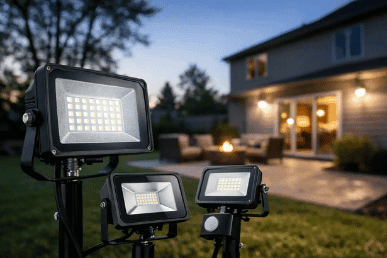
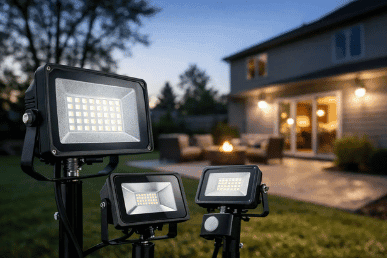
LED flood fixtures are designed to throw broad, usable light across open spaces, building exteriors, work yards, signage, and access points. In commercial settings, they are commonly used for parking lots, service entrances, dumpster enclosures, walkways, storage areas, and wall-washing applications. In residential use, they are a practical fit for driveways, backyards, garages, and general security lighting.
What makes them so widely specified is the balance of output and efficiency. Compared with legacy metal halide or halogen flood lighting, LED options reach full brightness quickly, draw less wattage, and maintain more consistent performance over time. That matters when the fixture is mounted high, difficult to access, or part of a larger project where maintenance costs add up fast.
The catch is that not every flood light is built for every site. A homeowner lighting a backyard patio does not need the same fixture as a contractor lighting a service yard or an electrical buyer sourcing for a multi-building commercial property. Matching the fixture to the application is where the real value is.
How to choose LED flood lights outdoor for the job
The first spec most buyers look at is wattage, but lumen output is the better starting point. Wattage tells you energy use. Lumens tell you how much light the fixture produces. Two flood lights with similar wattage can deliver very different performance, so if the goal is visibility and coverage, lumens should lead the conversation.
Mounting height is next. A fixture mounted at 10 to 12 feet for a residential garage or small commercial entry will need a different beam pattern than one installed at 20 to 30 feet on a pole or building wall. Lower mounting heights usually benefit from a wider beam to spread light evenly. Higher mounting heights often require a more controlled distribution so the light reaches the ground with useful intensity instead of scattering outward.
Color temperature also affects the result. Many outdoor flood applications use 4000K or 5000K because they provide a crisp, clear appearance that supports visibility and site security. Warmer color temperatures may make sense in residential or decorative settings, but for commercial and industrial exterior use, neutral to cool white is often preferred because it improves contrast and perceived brightness.
Then there is housing durability. For outdoor use, fixture construction matters as much as optical performance. Look at the materials, lens quality, gasketing, and environmental rating. A flood light mounted under a soffit in a mild climate faces less stress than one installed on an exposed wall in a coastal area, warehouse yard, or industrial site. Weather resistance, corrosion protection, and thermal management all affect long-term reliability.
Beam angle and distribution matter more than many buyers expect
A common mistake with LED flood lights outdoor is assuming more brightness solves every problem. It does not. If the beam angle is wrong, even a powerful fixture can create glare, hot spots, and dark edges.
Wide beams work well when the fixture is mounted close to the area being lit and the goal is broad coverage. Narrower or more controlled distributions are better when the fixture is mounted higher or needs to push light farther. For example, lighting a small rear entrance is a different task than lighting a vehicle lot, side yard, or sports area. The more specific the application, the more important distribution becomes.
This is where project support can make a difference. On a multi-fixture layout, spacing and aiming need to work together. Overlapping coverage improves uniformity, but too much overlap wastes output and increases glare. A fixture that looks right on paper may still perform poorly if its distribution does not match the site geometry.
Voltage, controls, and compatibility should be confirmed early
For straightforward replacements, line voltage compatibility may seem obvious, but it should still be verified. Commercial and industrial jobs often involve different electrical conditions, and choosing the wrong voltage range can delay installation. The same goes for controls.
Some outdoor flood lights are ordered for simple on-off operation. Others need photocells, motion sensors, timers, or integration with existing control systems. Those decisions affect both fixture selection and installation planning. If the site owner wants dusk-to-dawn operation at one location and occupancy-based activation at another, that should be addressed before the order is placed.
Retrofitting older systems also requires attention to mounting and aiming hardware. A fixture may meet the electrical and photometric requirements but still create unnecessary labor if the bracket style or form factor is a poor fit for the existing location.
Commercial, industrial, and residential needs are not the same
For commercial properties, the priority is often balanced site coverage, energy savings, and appearance. Parking areas, sidewalks, storefront perimeters, and service corridors need consistent light levels without excessive glare that affects customers or neighboring properties. Here, fixture finish, visual uniformity, and control strategy all matter.
Industrial sites usually place more emphasis on rugged construction and dependable performance in harsher conditions. Distribution yards, equipment areas, loading zones, and exterior workspaces may require higher output, heavier-duty housings, and stronger resistance to moisture, dust, and temperature swings. In these environments, fixture longevity is closely tied to maintenance planning and operating cost.
Residential buyers are often focused on security, driveway visibility, and ease of installation. A homeowner may not need a full site lighting plan, but they still benefit from the same basic principles: enough light for the task, the right beam spread, and a fixture that will not require frequent replacement.
What to watch for when comparing fixtures
Price matters, especially on larger projects, but fixture cost alone does not tell you much about value. A lower-cost flood light can become expensive if it fails early, delivers poor coverage, or creates installation complications. On the other hand, not every site needs the most advanced or highest-output model in the catalog.
It helps to compare fixtures based on expected service life, warranty support, build quality, photometric suitability, and ordering consistency. For contractors and procurement teams, consistency is especially important. Reordering matching fixtures for phased projects, tenant improvements, or maintenance stock is much easier when the product line is stable and clearly specified.
It is also worth checking whether the fixture is intended for the exact application you have in mind. Some products are excellent for general building-mounted flood lighting but not ideal for signage, landscape use, or high-mount security lighting. The difference is not always obvious from basic product labels.
When a standard flood light is enough and when it is not
Some jobs are simple. A replacement flood for a small exterior door, detached garage, or residential side yard may only require moderate lumen output, standard voltage, and basic weather resistance. In that case, a dependable general-purpose fixture is often the right call.
Other jobs need a more consultative approach. Multi-tenant properties, warehouses, schools, retail centers, and industrial facilities often have mixed outdoor lighting needs across the same site. One area may call for broad building wash, another for targeted security lighting, and another for higher-output illumination around loading or traffic zones. Trying to solve all of that with one generic flood light usually leads to uneven results.
That is why many buyers work with supply partners that can help narrow options by application, mounting condition, and performance target. Beacon Lighting Supply supports that kind of purchasing process with access to lighting specialists, project-ready product depth, and volume pricing for larger orders.
LED flood lights outdoor are a long-term decision
A flood fixture is rarely just a one-time purchase. It becomes part of the site's operating environment for years, affecting maintenance cycles, nighttime visibility, energy use, and even how secure a property feels. Choosing a fixture with the right output, distribution, construction, and controls pays off long after installation day.
If you are sourcing LED flood lights outdoor for a home, a commercial property, or an industrial project, start with the site conditions instead of the sticker price. The best fixture is the one that fits the application cleanly, installs without surprises, and keeps performing when the job is no longer new.