
Beacon Lighting Supply | Lighting the Way
A dated troffer layout can make a clean office feel tired, while uneven light in a classroom, clinic, or retail floor creates problems you notice every day. Flat panel LED lights solve that issue with a low-profile fixture format that delivers broad, consistent illumination, modernizes the ceiling plane, and cuts maintenance compared to legacy fluorescent systems.
For contractors, facility teams, and procurement buyers, that matters because panel fixtures are rarely a cosmetic upgrade alone. They affect labor time, energy use, occupant comfort, and how easily a site can be maintained over the next several years. Choosing the right panel is less about chasing a spec sheet and more about matching fixture construction, light output, controls, and installation method to the space.
Why flat panel LED lights are a standard commercial choice
Flat panels have become a go-to fixture for offices, schools, healthcare spaces, conference rooms, corridors, and retail applications because they address several common pain points at once. They provide a broad light distribution that helps reduce the cave effect you often get with narrower beam fixtures, and they do it in a clean form factor that works with modern ceilings.
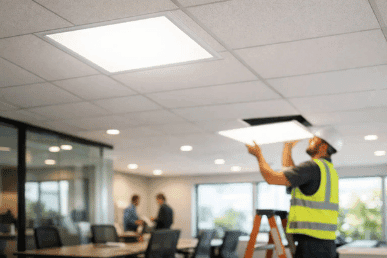
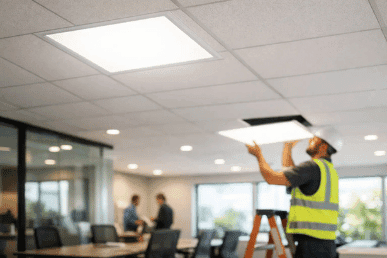
They also simplify LED upgrades in many existing buildings. In suspended grid ceilings, a panel can often replace an older fluorescent troffer with less disruption than a more specialized fixture type. That makes them attractive for renovation work where speed, appearance, and predictable performance all matter.
Another reason buyers choose panels is maintenance planning. With fluorescent systems, lamp changes, ballast failures, and inconsistent lamp performance add up over time. LED panels reduce those service calls, which is especially valuable across larger portfolios such as schools, offices, medical properties, and multi-site retail.
What actually separates one panel from another
At a glance, many flat panels look interchangeable. In practice, the differences show up quickly once the fixture is in the ceiling.
Light quality and distribution
The first question is not just how bright the fixture is, but how it delivers light. A panel with poor diffusion may create bright spots, edge inconsistency, or uncomfortable glare. In administrative offices and classrooms, that can affect visual comfort more than buyers expect. A well-designed panel produces even illumination across the lens and supports a more usable working environment.
Color temperature also changes how a space feels and functions. A 3500K or 4000K panel is often a practical fit for offices, education, and healthcare support areas because it feels neutral without being too cold. Retail and task-driven commercial spaces may lean brighter or cooler depending on the goal. There is no universal best option - it depends on the application, ceiling height, wall finishes, and the kind of work being done.
Efficacy and operating cost
Higher efficacy means more usable light per watt, which directly affects long-term operating cost. In projects with dozens or hundreds of fixtures, modest differences in wattage can have a meaningful impact on the utility bill. That said, the highest efficacy option is not automatically the best value if it compromises light quality, driver reliability, or compatibility with controls.
Commercial buyers usually benefit from evaluating the total package: delivered light, expected life, driver performance, and warranty support. The cheapest panel on paper can become the expensive choice if failures create labor costs later.
Driver quality and controls
The driver is one of the most important parts of the fixture, especially in commercial retrofits and new construction where dimming or control integration is required. If the project includes 0-10V dimming, occupancy sensors, daylight harvesting, or networked controls, the panel and driver need to be selected with that end use in mind.
This is where many projects run into avoidable delays. A fixture may appear to meet the brightness and size requirement, but if the driver does not pair well with the intended control strategy, performance issues follow. For project buyers, confirming driver compatibility up front is usually time well spent.
Flat panel LED lights by installation type
Fixture size and mounting method shape the buying decision as much as lumen output.
Recessed panels for grid ceilings
Recessed flat panels are the most common choice in commercial interiors with T-grid ceilings. They provide the cleanest finished look and are often the most straightforward retrofit path when replacing fluorescent troffers. In offices, schools, medical offices, and municipal buildings, this remains the standard application.
Surface-mount panels
Surface-mount options are useful when a suspended ceiling is not available. They work well in finished spaces where a low-profile fixture is still preferred, and they can help modernize rooms that would not accept a recessed troffer format. For many renovation projects, this expands the number of spaces where a panel-style fixture makes sense.
Suspension mounting
Suspended mounting is often selected for architectural offices, open commercial interiors, and spaces where fixture presence is part of the design. It can also improve light distribution in rooms with higher ceilings or exposed structure. The trade-off is that suspended installations typically require more planning and a stronger focus on visual layout.
Where panels perform best
Flat panels are strongest in spaces that need wide, even illumination and a professional finish. Offices are the obvious example, but they are far from the only one.
In schools and training facilities, panels support comfortable general lighting for long occupied hours. In healthcare-adjacent spaces such as waiting rooms, exam support areas, and administrative zones, they help create a bright, orderly environment. In retail, they can provide clean ambient lighting while accent fixtures handle merchandising emphasis. They are also a practical fit for corridors, breakrooms, conference rooms, and property management common areas.
There are limits, though. In very high ceilings, heavy industrial spaces, or environments with moisture, dust, washdown requirements, or hazardous conditions, a panel may not be the correct fixture type. High bays, vapor-tight fixtures, or hazardous location products may be the better answer. The right solution depends on the environment, not just the desired look.
What to check before specifying or ordering
Buyers can avoid most panel-related issues by confirming a few project details early. Ceiling type comes first, because it determines whether recessed, surface, or suspended mounting is appropriate. Voltage, dimming requirements, and emergency backup needs should also be reviewed before the fixture is selected.
It is also worth checking the expected visual result. Two panels with similar output can look very different in the room depending on diffuser quality, spacing, and color temperature. If the project involves a large open office or a client-sensitive interior, consistency across the install matters.
For retrofit work, existing cutout conditions, ceiling grid dimensions, and branch circuit layout should all be verified. A panel that looks correct in a catalog but requires field modifications can slow the job and increase labor. Procurement teams managing multi-site upgrades should also pay attention to product continuity so future replacements match as closely as possible.
Buying for projects, not just fixtures
For one-off replacements, selecting a panel is usually straightforward. For larger jobs, the process changes. Contractors and facility buyers often need dependable stock, consistent specifications, and support with quantities, alternates, and compatibility questions. That is especially true when a project includes phased retrofits, tenant improvements, or multi-location rollouts.
A supply partner that understands commercial lighting can help narrow options based on application instead of forcing buyers to sort through look-alike products. That reduces quoting friction and helps prevent mismatched fixtures, driver issues, or avoidable delays in the field. Beacon Lighting Supply supports that process with access to commercial-grade fixture options, bulk purchasing support, and lighting specialists who can assist with project requirements.
Price still matters, of course. But in commercial lighting, the better purchasing decision is often the one that balances fixture cost with install efficiency, service life, warranty coverage, and the likelihood of getting the right product the first time. That is how projects stay on schedule and maintenance budgets stay under control.
Flat panel LED lights are popular because they solve real problems without adding complexity. When the panel is matched correctly to the ceiling, controls, and use case, it delivers the kind of dependable performance commercial spaces need. If you are planning a retrofit, tenant buildout, or volume purchase, a quick review of the application details up front usually saves far more time than it costs later.