Beacon Lighting Supply | Lighting the Way
A parking lot that looks fine on paper can still create problems at the building perimeter. Dark side doors, uneven light at loading areas, and glare near walkways all point back to one fixture category that gets specified too casually. Commercial wall pack lights do more than add exterior illumination - they affect security, visibility, energy use, maintenance schedules, and how a property performs after hours.
For contractors, property managers, and facility teams, the right wall pack is rarely just a matter of matching wattage. You need the right distribution, the right housing, the right control strategy, and the right fixture style for the site. A poor choice can leave shadows where you need coverage or create spill light that brings complaints. A good choice gives you dependable perimeter lighting that holds up in daily service and simplifies long-term maintenance.
What commercial wall pack lights are meant to do
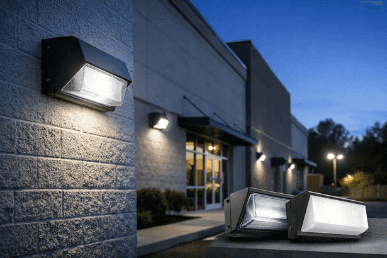
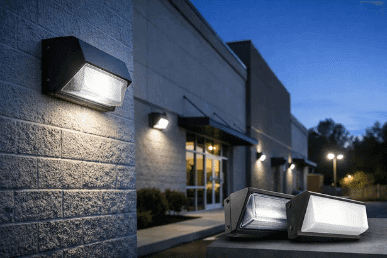
Commercial wall pack lights are exterior-mounted fixtures typically installed on building walls to light entry points, service corridors, walkways, loading zones, alleys, and perimeter areas. Their job is straightforward - deliver useful, durable light exactly where a site needs it without wasting output or creating unnecessary glare.
That sounds simple, but application matters. A rear egress door at a small office needs something very different from a multi-tenant retail center, a warehouse truck court, or a school campus. The fixture has to match mounting height, setback from the area being lit, operating hours, local code requirements, and the surrounding environment.
This is why wall packs are often part of a larger exterior lighting plan rather than a stand-alone purchase. Even when you are replacing existing fixtures one-for-one, it pays to reassess light distribution, controls, and fixture condition before ordering a case of replacements.
Types of commercial wall pack lights
The biggest decision is usually the fixture style and optical control. Different versions solve different problems, and the trade-offs are real.
Full cutoff and semi-cutoff wall packs
Full cutoff wall packs are designed to push light downward with minimal uplight and reduced glare. They are a strong fit for properties where light trespass matters, such as office buildings, medical facilities, schools, multifamily sites, and areas near residential boundaries. If your goal is cleaner distribution and better code alignment, full cutoff models are usually the safer choice.
Semi-cutoff wall packs allow more side and forward light, which can help in some general perimeter applications. They may create a brighter visual impression, but they can also produce more glare and less control. In retrofit projects, these fixtures sometimes mirror older site conditions, but that does not always mean they are the best option going forward.
Forward-throw wall packs
Forward-throw wall packs are useful when the fixture needs to project light farther out from the building. This can help with wider pedestrian paths, service drives, or open areas where mounting points are limited to the wall itself. The benefit is broader reach. The downside is that poor aiming or overpowered output can create hot spots and uneven transitions.
Traditional versus architectural styles
Traditional wall packs are often selected for utility-driven commercial and industrial settings where performance and durability take priority over appearance. Architectural wall packs are more design-conscious and may better suit offices, hospitality, schools, churches, and upgraded retail exteriors. The choice depends on whether the project is purely functional or also tied to curb appeal and tenant perception.
How to size commercial wall pack lights correctly
One of the most common mistakes is selecting fixtures by wattage alone. LED wall packs have changed that equation. Lower wattage can now deliver much higher usable light than older HID fixtures, so direct watt-for-watt replacement is not always the right move.
A better approach is to look at mounting height, spacing, target foot-candle levels, and beam distribution. A fixture mounted at 8 to 10 feet over a personnel door has different needs than one mounted at 18 to 20 feet on a warehouse wall. Light that works at one height may be too concentrated or too weak at another.
It also helps to think in zones. Building entrances need visibility and vertical illumination so faces, locks, signage, and thresholds are clearly visible. Walkways need smooth coverage without harsh contrast. Loading areas need stronger output and durability. Dumpster enclosures and service yards often need enough light for safety and security, but not so much that they create objectionable spill.
If your site has repeated mounting points and predictable spacing, fixture selection becomes more straightforward. If conditions vary from wall to wall, a mixed approach may be more effective than forcing one SKU into every location.
Key specs that matter before you order
Procurement gets easier when the technical filters are clear. In most commercial wall pack lights, these are the details that deserve attention first.
Color temperature affects both appearance and function. Many commercial sites use 4000K or 5000K for crisp visibility outdoors. 4000K often feels more balanced around offices, schools, and mixed-use properties, while 5000K can make sense for security-focused and industrial applications. There is no universal best answer. It depends on the site and what the customer expects the property to look like at night.
Voltage compatibility is another checkpoint that should never be assumed. Some projects require standard 120-277V, while others need fixtures that can support higher voltage ranges. On replacement jobs, confirming driver compatibility before shipment saves time and avoids expensive field delays.
Housing and lens materials matter in exposed environments. Die-cast aluminum housings, durable finishes, and impact-resistant lenses are important when fixtures will face weather, debris, heat, or repeated service demands. Ratings for wet location use and environmental protection should be reviewed as part of the fixture selection, not after the fact.
Photocells and occupancy controls can improve efficiency, but they should fit the application. A dusk-to-dawn photocell works well in many perimeter lighting scenarios. Motion sensing may be useful in lower-traffic service areas, though it is not always ideal where consistent illumination is expected for security or customer access.
LED upgrades and retrofit considerations
Most buyers shopping commercial wall pack lights today are either specifying LED from the start or replacing outdated HID fixtures. The advantages are familiar - lower energy consumption, longer service life, reduced relamping, and more consistent output. But retrofit projects still need careful review.
First, check whether the existing layout actually supports the current lighting goal. Many older installations used high-wattage fixtures with poor optics, which means replacing them one-for-one with LED may improve efficiency but still leave the site unevenly lit. If spacing is too wide or mounting heights are inconsistent, fixture changes alone may not fully solve the problem.
Second, pay attention to appearance across the property. Mixing old and new fixture styles can create a patchwork look that some owners accept and others reject. On customer-facing buildings, consistency may justify a broader upgrade rather than spot replacement.
Third, think about maintenance strategy. Standardizing around a smaller group of fixture types and driver configurations can simplify stocking and replacement planning across multiple sites.
Where buyers get wall pack selection wrong
Overlighting is one common issue. More lumens do not always mean better security or better usability. Too much brightness near doors and walkways can create glare, reduce visual comfort, and make adjacent areas feel darker by comparison.
Underspecifying is just as common. A low-cost fixture may look acceptable on a spec sheet but fall short on distribution, build quality, surge protection, or driver reliability. For sites that operate every night, fixture durability matters as much as initial price.
Another mistake is treating every exterior wall the same. Front entrances, side access points, rear service areas, and tenant exits each have different lighting priorities. Matching fixture type to use case usually delivers better results than using one fixture across the entire building.
Choosing a supply partner for commercial wall pack lights
For many buyers, the challenge is not finding a wall pack. It is finding the right wall pack quickly, with accurate technical guidance and reliable product availability. When timelines are tight or projects involve multiple building types, access to specialists can prevent expensive misorders.
That is where a distributor with real category depth adds value. Beacon Lighting Supply supports contractors, facilities teams, and procurement buyers with product selection help, bulk ordering support, and dependable fixture options for exterior commercial applications. If you are sourcing for a single replacement or a larger site package, getting the spec right before the order goes out saves labor, callbacks, and frustration.
The best commercial wall pack lights are not the ones with the biggest numbers on the box. They are the fixtures that fit the site, meet the operating demands, and keep performing without becoming a maintenance problem. If you are planning an exterior upgrade or replacing aging perimeter fixtures, take the extra step to match optics, controls, and construction to the job - it pays off long after installation day.