
Beacon Lighting Supply | Lighting the Way
When a maintenance cart is waiting, tenants are calling, or a production area cannot afford uneven light, ordering the wrong replacement fluorescent tubes costs more than a simple return. It slows down repairs, creates compatibility issues, and turns a routine lamp change into a jobsite problem. The fastest path is knowing exactly what you are replacing and what conditions the lamp needs to handle.
For contractors, facilities teams, and procurement buyers, fluorescent replacements are rarely just about wattage. Tube diameter, length, pin base, ballast compatibility, color temperature, and application all matter. A lamp that looks close on paper can still fail to start properly, underperform, or create inconsistent light across a space.
Why replacement fluorescent tubes still require careful matching
Fluorescent lighting remains in service across offices, schools, retail stores, garages, utility rooms, and older commercial buildings. Many facilities are gradually moving to LED, but that does not eliminate the need to maintain existing fluorescent systems during phased upgrades, budget cycles, or fixture-by-fixture replacements.
That is where buyers often run into trouble. Older buildings may contain multiple lamp types installed over time. A single property can have T8 lamps in troffers, T12 lamps in back-of-house areas, and compact fluorescent products in other fixtures. Ordering by visual guesswork is risky because similar tube lengths and shapes do not guarantee electrical compatibility.
A reliable replacement starts with the exact lamp designation. If the existing lamp is labeled F32T8, for example, that code tells you more than just the style. It points to wattage, tube family, and diameter. Pair that with the base type and ballast information, and you have a much better chance of getting a correct match on the first order.
How to identify the right replacement fluorescent tubes
The most practical place to start is the lamp already installed. In many cases, the printing on the tube will provide the lamp family, wattage, and color information. If the label is faded or missing, the fixture itself and ballast label can fill in the gaps.
Start with tube size and lamp family
T5, T8, and T12 are the most common linear fluorescent categories. The number refers to the tube diameter in eighths of an inch. A T8 is eight eighths, or 1 inch in diameter. A T12 is thicker at 1.5 inches. That difference matters because these lamps are not interchangeable in every fixture, even if the overall length appears similar.
Length is just as important. Common linear options include 2-foot, 3-foot, 4-foot, and 8-foot lamps, but exact specifications still matter. A 4-foot lamp is not enough information by itself. You need to know whether it is, for example, a 32-watt T8 or a different configuration tied to a specific ballast and fixture setup.
Check the base and pin configuration
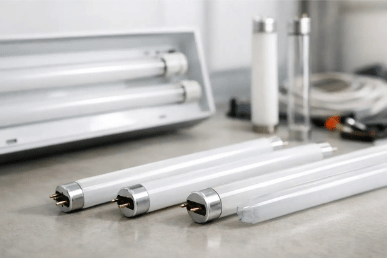
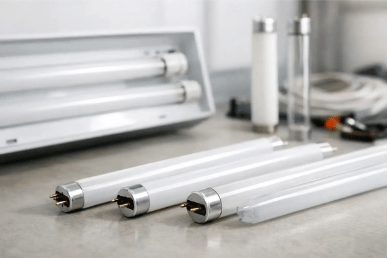
Most linear fluorescent tubes use bi-pin bases, but there are variations. T8 and T12 lamps often use medium bi-pin bases, while T5 lamps generally use miniature bi-pin bases. If the pins do not match the socket, the lamp will not install correctly, and forcing a fit can damage the lampholder.
This is especially relevant in mixed inventories. Maintenance teams sometimes stock lamps by length only, which can lead to avoidable confusion when the correct base type is overlooked.
Confirm ballast compatibility
Ballast compatibility is where many replacement issues show up. The ballast regulates lamp starting and operation, and the lamp must match what the ballast is designed to run. A lamp with the wrong electrical characteristics may flicker, fail early, or not light at all.
If you are replacing fluorescent with fluorescent, matching the existing lamp specification is usually the safest move. If you are planning a conversion, that becomes a different project with different requirements. In operating fluorescent systems, the ballast is not a detail to ignore.
Color temperature and light quality are not minor details
In storage rooms and mechanical spaces, slight color differences may not matter much. In offices, medical environments, retail floors, and classrooms, they do. Replacing lamps with the wrong color temperature can make a clean installation look unfinished because one section of the room appears cooler, warmer, or dimmer than the rest.
Common fluorescent color temperatures include 3000K, 3500K, 4100K, and 5000K. A 4100K lamp is often used in commercial interiors because it provides a neutral, functional light. A 5000K lamp may be preferred in task-oriented or industrial settings where a brighter daylight appearance is desired. The best choice depends on the application, but the key is consistency across the space.
Color rendering can also matter, particularly in retail, healthcare, or anywhere visual accuracy affects the environment. If lamps are being replaced in a public-facing area, matching light quality is part of maintaining the space, not just keeping fixtures on.
Common mistakes when ordering replacement fluorescent tubes
One of the most common mistakes is assuming all 4-foot tubes are the same. They are not. Diameter, wattage, ballast requirements, and pin base all affect compatibility. Another frequent issue is mixing old and new lamp types within the same area, which can create visible color variation and uneven output.
Buyers also run into problems when they replace lamps without addressing aging ballasts. If multiple lamps are failing early or flickering, the ballast may be part of the problem. Replacing lamps alone may restore operation temporarily, but it will not always solve the root issue.
There is also the stockroom problem. Facilities with several buildings or legacy spaces often keep mixed inventory with limited labeling. That leads to wasted labor and duplicate ordering. For larger operations, it usually makes sense to standardize what can be standardized and document what still needs site-specific replacements.
When to replace fluorescent tubes and when to consider a broader upgrade
There are plenty of situations where direct fluorescent replacement is the right call. If a facility is maintaining existing fixtures for the near term, if budgets are tied to maintenance rather than capital improvement, or if only a limited number of lamps are needed for service continuity, replacement keeps the job moving.
That said, there are cases where continued lamp replacement may not be the most efficient long-term decision. If a site is seeing recurring ballast issues, rising maintenance time, or hard-to-source lamp types, a retrofit or fixture upgrade may make more sense. The right path depends on how long the existing system is expected to stay in service and how critical that area is to operations.
For many commercial buyers, the practical answer is not all-or-nothing. They maintain fluorescent systems where needed while planning targeted LED upgrades in high-use or problem-prone areas. That approach can protect budgets without letting maintenance become reactive.
Replacement fluorescent tubes for commercial and industrial settings
Application matters. In a warehouse, buyers may prioritize dependable startup, consistent output, and bulk availability. In an office or school, visual uniformity and occupant comfort tend to carry more weight. In utility or industrial areas, durability and compatibility with demanding operating conditions may be the bigger concern.
That is why part numbers alone do not tell the full story. The correct lamp is the one that fits the fixture, works with the ballast, and supports the use of the space. Procurement teams managing multiple properties often benefit from working with a supplier that can help sort lamp cross-references, recurring volume needs, and replacement planning by application.
Beacon Lighting Supply supports that process with a broad catalog and access to lighting specialists who can help confirm compatibility, organize larger orders, and assist with project-based sourcing when a simple restock turns into a wider maintenance or retrofit need.
A smarter way to order replacement fluorescent tubes
The simplest way to avoid downtime is to treat lamp replacement like a specification task, not a guess. Verify the lamp code, measure only when needed, check the base, review the ballast, and keep color temperature consistent with the existing installation. If the system has repeated failures, look beyond the tube itself before placing another order.
For one-off lamp changes, that discipline saves a trip. For contractors and facilities teams managing dozens or hundreds of fixtures, it saves labor, reduces returns, and keeps lighting maintenance predictable. When the right information is collected upfront, ordering becomes faster and more accurate.
If you are sourcing replacement fluorescent tubes for a property, a service contract, or a larger maintenance program, the goal is not just finding a lamp that looks close. It is getting the right product for the fixture, the environment, and the schedule so the job stays on track.