
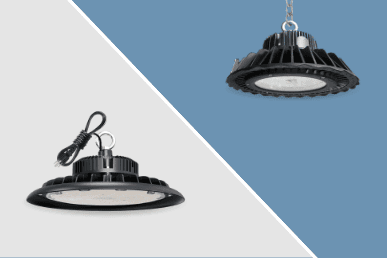
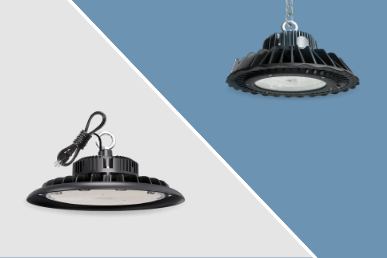
Beacon Lighting Supply | Lighting the Way
High Bay vs. Low Bay Lighting: Which One Do You Need?
When planning lighting for a commercial or industrial space, one of the most important decisions you’ll make is whether you need high bay or low bay lighting. Choosing the wrong fixture type can lead to poor visibility, higher energy costs, and uneven light distribution—especially in warehouses, manufacturing facilities, and large retail environments.
In this guide, we’ll break down:
-
What high bay and low bay lighting are
-
The key differences between them
-
Where each type works best
-
How ceiling height affects your choice
-
Mounting options and beam angles
-
LED considerations for energy efficiency
By the end, you’ll know exactly which solution fits your space.
What Is High Bay Lighting?
High bay lighting is designed for spaces with ceilings 20 feet or higher. These fixtures are engineered to project light from significant heights down to the floor efficiently and evenly.
Common Applications:
-
Warehouses
-
Distribution centers
-
Manufacturing facilities
-
Gymnasiums
-
Aircraft hangars
-
Big-box retail stores
Because of the mounting height, high bay fixtures require:
-
Higher lumen output
-
Tighter beam control
-
Strong reflectors or optics
Without the right beam angle, light can become scattered and ineffective at ground level.
What Is Low Bay Lighting?
Low bay lighting is designed for ceilings between 12 and 20 feet. These fixtures provide wider beam distribution because they don’t need to push light as far downward.
Common Applications:
-
Smaller warehouses
-
Workshops
-
Retail spaces
-
Auto shops
-
Storage areas
-
Garages
Since the mounting height is lower, extremely high lumen packages aren’t necessary—and can actually cause glare.
High Bay vs. Low Bay: Key Differences
Here’s a side-by-side comparison to simplify things:
| Feature | High Bay Lighting | Low Bay Lighting |
|---|---|---|
| Ceiling Height | 20+ feet | 12–20 feet |
| Lumen Output | High (15,000–60,000+ lumens) | Moderate (8,000–20,000 lumens) |
| Beam Angle | Narrow to medium | Wide |
| Common Shapes | UFO, Linear | Linear, Canopy |
| Typical Use | Industrial & large spaces | Retail & smaller commercial |
The biggest determining factor? Ceiling height.
Why Ceiling Height Matters So Much
Lighting performance depends heavily on the distance between fixture and work surface.
If you install low bay fixtures in a 30-foot warehouse:
-
Light won’t reach the floor properly
-
You’ll see dark spots
-
You’ll need more fixtures
If you install high bay fixtures in a 14-foot shop:
-
You risk glare
-
You waste energy
-
Light may feel harsh
The goal is balanced illumination without over-lighting.
Beam Angles Explained
Beam angle determines how widely light spreads.
High Bay Fixtures
-
60° beam → Tall racking aisles
-
90° beam → General warehouse use
-
120° beam → Wider open areas
Low Bay Fixtures
-
Usually 120° or wider
-
Designed for broad coverage at shorter distances
For facilities with tall shelving, narrower beams reduce wasted light and improve visibility down aisles.
Mounting Options
Both high and low bay lights offer multiple mounting styles:
-
Hook mount (common for UFO high bays)
-
Pendant mount
-
Surface mount
-
Chain mount
-
Ceiling bracket
High bays often hang from ceilings with hooks or chains to maximize downward projection, while low bays are frequently surface-mounted.
LED vs. Traditional HID or Fluorescent
Today, most facilities are switching to LED high bay and low bay lighting.
Why LED Is the Standard:
-
50–70% energy savings over HID
-
Instant-on capability
-
Lower maintenance
-
Longer lifespan (50,000+ hours)
-
Better color rendering
Older metal halide fixtures may take minutes to warm up. LED eliminates that issue entirely.
If you’re upgrading from HID, an LED high bay can often replace a 400W metal halide with a 150W–200W LED equivalent.
How to Choose the Right Option
Ask yourself these questions:
1. What is your ceiling height?
-
Under 20 ft → Low Bay
-
Over 20 ft → High Bay
2. What activities happen below?
-
Detailed assembly → Higher foot-candle levels
-
Storage only → Moderate lighting
3. Do you have tall racks?
-
Yes → Consider narrower beam high bays
-
No → Wider distribution may be better
4. Are energy savings a priority?
(They usually are.) LED is the clear winner.
Common Mistakes to Avoid
❌ Choosing based on wattage alone
❌ Ignoring beam angle
❌ Over-lighting small spaces
❌ Under-lighting tall warehouses
❌ Not considering glare control
Lighting design should always be based on lumens and distribution, not just watts.
What About Foot-Candles?
Foot-candles measure light at the work surface.
General guidelines:
-
Warehouse storage → 10–30 foot-candles
-
Manufacturing → 30–50 foot-candles
-
Retail → 30–50 foot-candles
-
Detailed tasks → 50+ foot-candles
High bays are typically required to achieve adequate foot-candles in tall spaces.
Real-World Example
Let’s say you operate:
-
A 28-foot ceiling warehouse with pallet racking
-
Forklift traffic
-
Moderate picking activity
You likely need:
-
LED high bay fixtures
-
Around 20,000–30,000 lumens per fixture
-
90° beam angle
-
Proper spacing layout
Now imagine:
-
A 16-foot auto shop
-
Open floor plan
You would likely choose:
-
LED low bay fixtures
-
12,000–15,000 lumens
-
120° beam angle
Same building type, different ceiling height → different solution.
Final Answer: Which One Do You Need?
It really comes down to this:
-
Ceilings 20 feet or higher → High Bay Lighting
-
Ceilings 12–20 feet → Low Bay Lighting
If you’re on the borderline (around 18–22 feet), fixture design, beam angle, and layout become especially important.
When in doubt, a professional lighting layout can ensure:
-
Proper foot-candle levels
-
Optimal fixture spacing
-
Maximum energy efficiency
-
Compliance with lighting standards
Bottom Line
Choosing between high bay and low bay lighting isn’t complicated—but it is important. The right fixture improves productivity, safety, and long-term energy savings.
If you're upgrading an industrial or commercial space, start with ceiling height, determine your lighting requirements, and select fixtures designed specifically for that environment.
The right lighting doesn’t just brighten a space—it improves how the space performs.