Beacon Lighting Supply | Lighting the Way
UFO vs. Linear High Bay Lights: Which Is Better for Your Facility?
When lighting a warehouse, manufacturing plant, distribution center, gymnasium, or other large commercial facility, choosing the right fixture is about more than simply finding a light with enough lumens.
The shape of the building, ceiling height, aisle configuration, mounting method, and type of work being performed can all affect which lighting system will provide the best results.
For facilities with high ceilings, two of the most common options are UFO LED high bay lights and linear LED high bay lights.
Both offer the energy efficiency, long lifespan, and powerful light output associated with modern LED commercial lighting. However, the way they distribute that light is very different.
So, when comparing UFO vs. linear high bay lights, which is better?
The answer depends largely on your facility.
What Are LED High Bay Lights?
LED high bay lights are high-output fixtures designed to illuminate commercial and industrial spaces with elevated ceilings. They are commonly installed in:
-
Warehouses
-
Distribution centers
-
Manufacturing facilities
-
Factories
-
Workshops
-
Gymnasiums
-
Aircraft hangars
-
Large retail facilities
-
Storage buildings
High bay fixtures are designed to deliver enough illumination from greater mounting heights while maintaining useful light levels at the floor and work surfaces.
Compared with older metal halide, HID, and fluorescent high bay systems, modern LED high bays can provide better energy efficiency, instant-on operation, longer service life, improved light distribution, and compatibility with lighting controls.
Two of the most popular configurations are UFO high bays and linear high bays.
What Is a UFO High Bay Light?
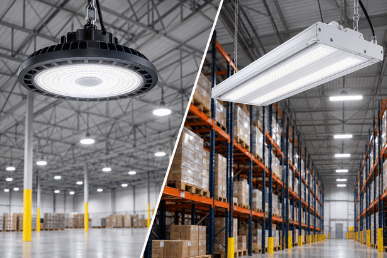
A UFO high bay light is a compact, round LED fixture named for its disc-like shape.
Unlike the large reflectors traditionally associated with metal halide high bays, modern UFO LED high bays pack a high lumen output into a relatively small fixture.
Their circular design generally produces a broad, symmetrical distribution of light, making UFO fixtures especially useful in large open areas.
Where Do UFO High Bays Work Best?
UFO high bays are commonly used in:
-
Open warehouses
-
Manufacturing floors
-
Workshops
-
Loading and receiving areas
-
Aircraft hangars
-
Gymnasiums
-
Large storage areas
-
Industrial facilities
-
Big-box commercial spaces
If the floor below the fixture is relatively open rather than divided into long rows of shelving, a UFO high bay is often an excellent option.
For example, the Westgate Manufacturing UFO Highbay G2 Sensor Ready Light available from Beacon Lighting Supply offers selectable 80W, 100W, and 150W settings, selectable 3000K, 4000K, and 5000K color temperatures, 0–10V dimming, and a sensor-ready design.
What Is a Linear High Bay Light?
A linear LED high bay uses a longer, rectangular fixture design rather than the round shape of a UFO high bay.
That shape allows linear fixtures to distribute illumination across a longer, more rectangular area.
This can be particularly useful in facilities containing aisles, pallet racks, conveyor systems, production lines, or long work areas.
Where Do Linear High Bays Work Best?
Linear high bays are commonly used in:
-
Warehouse aisles
-
High-rack storage facilities
-
Distribution centers
-
Manufacturing lines
-
Assembly areas
-
Commercial storage facilities
-
Retail warehouses
-
Picking and packing areas
Beacon Lighting Supply carries a variety of linear high bay fixtures, including the SLG HL G3 Linear High Bay, which produces up to 36,000 lumens and includes an aisle lens designed for applications where directional distribution is important.
UFO vs. Linear High Bay Lights: What's the Difference?
Although both fixture types are designed for high-ceiling applications, their biggest difference is light distribution.
A UFO fixture acts more like a point source, spreading light outward from a compact circular fixture. A linear high bay distributes light across a longer area that can more closely follow the shape of an aisle or work zone.
That difference can have a major impact on lighting quality.
UFO High Bay
Shape: Round and compact
Light pattern: Broad and generally symmetrical
Best for: Open areas
Installation: Often simple due to compact, single-point mounting options
Common applications: Open warehouses, gyms, manufacturing floors, workshops and large industrial areas
Linear High Bay
Shape: Long and rectangular
Light pattern: Wide, elongated or aisle-oriented
Best for: Structured layouts
Installation: Typically suspended using chains, cables or other mounting systems
Common applications: Warehouse aisles, pallet racking, production lines, distribution centers and task-oriented spaces
Neither fixture is inherently better. The goal is to match the fixture's distribution to the layout of the facility.
1. Consider Your Facility Layout
Your floor plan should be one of the first factors you consider.
Imagine an open manufacturing floor with machinery spread throughout a large room. There may be few tall obstructions and no clearly defined aisles.
A UFO LED high bay can work extremely well because its broad distribution helps illuminate the open area around each mounting point.
Now consider a warehouse filled with tall pallet racks.
Workers and forklift operators don't just need light directly underneath the fixture. They need visibility along the aisle and on the vertical surfaces of the racks.
In that situation, a linear high bay with an appropriate optical distribution may provide better coverage.
A simple rule of thumb is:
Open space = consider UFO high bays.
Long aisles or rows = consider linear high bays.
2. Think About Horizontal and Vertical Illumination
One of the biggest mistakes in warehouse lighting design is focusing exclusively on the floor.
In a storage facility, employees may spend much of their time looking at shelves, labels, cartons, racks, and inventory located above ground level.
That means vertical illumination matters too.
Linear high bays can be particularly useful in aisle applications because the fixture and optics can direct illumination along the length of the aisle and toward rack surfaces.
For a large open manufacturing area, however, that type of distribution may not be necessary. A UFO high bay's broader pattern may make more sense.
3. Ceiling Height and Fixture Spacing Matter
Ceiling height is another critical part of choosing commercial high bay lighting.
As mounting height increases, the fixture must deliver enough usable illumination to the working plane below. Beam angle, lumen output, fixture spacing, and the presence of obstructions all become increasingly important.
A high-output fixture isn't automatically the best choice.
Installing fixtures with excessive lumen output can waste energy and create uncomfortable glare. On the other hand, fixtures that are too widely spaced may create bright spots underneath the lights with darker areas between them.
The best lighting design balances:
-
Mounting height
-
Fixture lumen output
-
Beam angle
-
Fixture spacing
-
Target foot-candle levels
-
Uniformity
-
Rack and equipment locations
For large projects, a photometric lighting layout can help determine the appropriate fixture, wattage, quantity, and spacing before installation.
4. Compare Energy Efficiency — Not Just Wattage
One of the advantages of switching to LED warehouse lighting is the potential for substantial energy savings compared with older HID or fluorescent systems.
However, wattage alone doesn't tell you how efficiently a fixture produces light.
When comparing UFO and linear high bays, consider:
-
Total lumen output
-
Lumens per watt
-
Required number of fixtures
-
Operating hours
-
Dimming capability
-
Occupancy sensor compatibility
-
Fixture placement
A lower-wattage fixture isn't necessarily the more efficient solution if you need significantly more fixtures to achieve the required illumination.
Instead, consider the performance of the entire lighting system.
5. Take Advantage of Selectable LED High Bays
Modern commercial LED fixtures are increasingly available with selectable wattage and color temperature settings.
This gives contractors and facility managers more flexibility during installation and can simplify inventory for facilities with multiple lighting requirements.
For example, a wattage-selectable fixture may allow the installer to adjust output based on the mounting height or task requirements rather than purchasing a completely different fixture.
Beacon Lighting Supply also offers the SLG LED Linear High Bay Selectable Control Gen1, featuring selectable 4000K/5000K color temperature, up to 40,500 lumens, and an aisle lens.
6. Don't Forget Lighting Controls
The fixture itself is only part of an efficient industrial lighting system.
Occupancy sensors and dimming controls can reduce unnecessary energy use in areas that aren't continuously occupied.
This is especially valuable in warehouses where certain aisles or storage areas may remain empty for long periods.
Rather than operating every high bay at full output throughout the entire shift, compatible controls can reduce light levels when an area is unoccupied and increase them when employees or equipment enter the space.
When selecting a high bay, look for features such as:
-
0–10V dimming
-
Occupancy sensor compatibility
-
Motion sensor receptacles
-
Daylight harvesting compatibility
-
Adjustable wattage
These capabilities can make the lighting system more adaptable while helping reduce operating costs.
7. Consider the Environment
Commercial and industrial facilities can expose lighting fixtures to conditions that don't exist in ordinary indoor environments.
Before choosing either a UFO or linear high bay, consider whether the fixture will be exposed to:
-
Dust
-
Moisture
-
High temperatures
-
Low temperatures
-
Vibration
-
Impact
-
Washdown conditions
Check each fixture's specifications and environmental ratings before installation.
For harsh industrial environments, the durability and compact construction of certain UFO high bays can be an advantage. However, properly rated linear fixtures can also be used in demanding applications.
The fixture should always be selected for the specific environment.
Which Is Better for a Warehouse?
For most warehouses, the answer depends on the rack configuration.
A warehouse with open bulk storage or large unobstructed areas may be an excellent candidate for UFO high bays.
A warehouse with long aisles and tall pallet racks may benefit more from linear high bays, particularly fixtures equipped with aisle optics.
Some facilities benefit from using both.
For example, a distribution center could use linear high bays over picking aisles while installing UFO fixtures over receiving, staging, loading, or open storage areas.
There's no requirement that an entire facility use the same high bay fixture.
Which Is Better for Manufacturing?
Again, consider the layout.
For a large open production floor, UFO high bays can provide powerful general illumination while keeping the fixture footprint relatively compact.
For manufacturing environments organized around long assembly lines, conveyors, or rows of workstations, linear fixtures may provide better uniformity along the working area.
Facilities performing detailed visual tasks should pay particular attention to uniformity, glare, color rendering, and task-level illumination rather than choosing fixtures based solely on lumen output.
UFO vs. Linear High Bay: Quick Comparison
| Factor | UFO High Bay | Linear High Bay |
|---|---|---|
| Fixture shape | Round/compact | Long/rectangular |
| Best layout | Open spaces | Aisles and rows |
| Warehouse racking | Can work depending on optics | Often preferred |
| Open manufacturing | Excellent option | Good option |
| Installation | Compact and often simple | Depends on mounting system |
| Light distribution | Broad/symmetrical | Elongated/directional |
| Vertical rack visibility | Depends on optics/layout | Often better with aisle optics |
| Sensors & dimming | Available | Available |
| Best choice | Open high-ceiling areas | Structured linear spaces |
So, Which High Bay Should You Choose?
When comparing UFO vs. linear high bay lights, there isn't a universal winner.
Choose a UFO high bay when your facility has a large, open floor plan and needs powerful general illumination from a compact fixture.
Choose a linear high bay when your facility contains long aisles, pallet racking, production lines, or other rectangular work zones where controlled, uniform distribution is especially important.
And for complex facilities, the best solution may be a combination of the two.
The most important thing is to avoid selecting a fixture based only on wattage or price. Consider the entire application: ceiling height, layout, required light levels, beam distribution, controls, environmental conditions, and long-term operating costs.
Find the Right LED High Bay Lighting for Your Facility
Whether you're replacing outdated metal halide fixtures, upgrading an existing warehouse lighting system, or planning lighting for a new commercial facility, Beacon Lighting Supply offers commercial and industrial LED high bay lighting for a variety of applications.
Need help determining which fixture makes sense for your project? Beacon Lighting Supply can help you compare options for your facility and find lighting that fits your application, performance requirements, and budget.