

Beacon Lighting Supply | Lighting the Way
Type III vs. Type V Light Distribution: Choosing the Right Outdoor Fixture
When selecting commercial outdoor lighting, choosing the right fixture involves more than comparing wattage, lumens, and color temperature. One of the most important factors in achieving effective illumination is understanding how a fixture distributes light across a designated area.
Whether you're illuminating a commercial parking lot, roadway, warehouse exterior, or outdoor pedestrian area, the light distribution pattern directly affects visibility, energy efficiency, and overall lighting performance.
Two of the most commonly used distributions in commercial LED area lighting are Type III and Type V. Although both are designed to illuminate large outdoor spaces, they distribute light differently and are suited to different applications.
Understanding the differences between Type III vs. Type V light distribution can help contractors, facility managers, and property owners select the most appropriate LED outdoor lighting fixtures for their projects.
What Is Light Distribution in Outdoor Lighting?
Light distribution refers to the direction and pattern in which a lighting fixture projects illumination onto a surface. Rather than simply measuring how much light a fixture produces, distribution describes where that light travels and how effectively it covers the intended area.
The Illuminating Engineering Society (IES) establishes standardized classifications for outdoor lighting distribution patterns. These classifications help lighting professionals determine which fixtures are best suited for particular applications.
The primary IES light distribution types include:
-
Type I: Narrow, elongated distribution commonly used for walkways and pathways.
-
Type II: Wider linear distribution suited for sidewalks and narrower roadways.
-
Type III: Broad, asymmetrical distribution commonly used for parking lots and roadways.
-
Type IV: Wide forward-throw distribution often used along building perimeters and property boundaries.
-
Type V: Symmetrical, circular distribution ideal for open areas requiring illumination in multiple directions.
Each distribution serves a specific purpose, making fixture placement and the layout of the illuminated area essential considerations when designing an outdoor lighting system.
For commercial properties, Type III and Type V distributions are particularly popular because they provide flexible solutions for parking lot lighting, site lighting, and general outdoor illumination.
What Is Type III Light Distribution?
Type III light distribution produces a broad, asymmetrical lighting pattern that projects illumination primarily forward and outward from the fixture.
Unlike symmetrical distributions, Type III directs more light toward one side of the mounting location, making it particularly effective when fixtures are positioned along the perimeter of an area.
The resulting illumination pattern is generally elongated, allowing a fixture to cover a relatively wide area without distributing equal amounts of light in every direction.
Common Applications for Type III LED Lighting
Type III distribution is frequently used in commercial outdoor lighting applications where fixtures are installed along the edges of a property.
Typical applications include:
-
Commercial parking lots: Illuminating parking spaces and driving lanes from perimeter poles.
-
Roadways: Providing coverage across wider streets and access roads.
-
Warehouse exteriors: Lighting outdoor loading areas and vehicle circulation routes.
-
Commercial properties: Illuminating building approaches and surrounding pavement.
-
Industrial facilities: Providing directional illumination across outdoor operational areas.
One of the primary advantages of Type III LED area lights is their ability to direct illumination toward the areas where it is needed most.
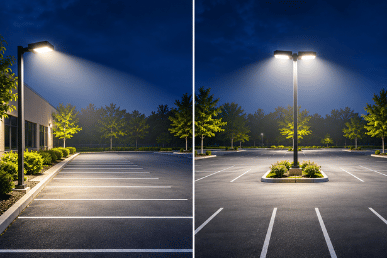
For example, when a light pole is installed near the edge of a commercial parking lot, Type III optics can project light toward the parking spaces rather than distributing equal illumination behind the pole.
This directional coverage can help reduce unnecessary light spill and improve the efficiency of the overall lighting layout.
However, Type III distribution does not automatically eliminate backlight. The actual amount of light extending behind the fixture depends on its optical design and photometric performance.
Benefits of Type III Light Distribution
Efficient directional coverage: Projects illumination across wider areas from perimeter mounting locations.
Reduced unwanted illumination: Can help limit light spill beyond property boundaries when properly selected and positioned.
Flexible installation: Suitable for pole-mounted and certain building-mounted outdoor lighting applications.
Improved lighting design: Helps lighting professionals direct illumination toward parking areas, roadways, and pedestrian routes.
For projects requiring broad directional coverage, Type III LED fixtures are often an excellent starting point.
Explore Beacon Lighting Supply's Type III and other LED area lighting options, including the EiKO VERT Type 3 LED Area & Site Light.
What Is Type V Light Distribution?
Type V light distribution produces a symmetrical, circular illumination pattern that extends outward in all horizontal directions from the fixture.
Unlike Type III, which concentrates more illumination toward one side, Type V distributes light evenly around the mounting location in terms of its directional symmetry.
This makes Type V particularly useful for lighting large, open spaces where illumination is needed on multiple sides of a pole or fixture.
Type V distribution is commonly associated with center-mounted outdoor area lights, although its suitability ultimately depends on the layout and lighting requirements of the property.
Common Applications for Type V LED Lighting
Type V LED area lights are frequently selected for open commercial spaces requiring broad, multidirectional coverage.
Typical applications include:
-
Large parking lots: Providing illumination around centrally located lighting poles.
-
Commercial plazas: Lighting open gathering areas and pedestrian spaces.
-
Industrial yards: Illuminating outdoor storage and operational areas.
-
Business campuses: Providing general area lighting around buildings and shared spaces.
-
Public spaces: Illuminating courtyards, parks, and other open areas.
For example, a centrally positioned pole in a commercial parking lot may benefit from Type V distribution because the fixture can illuminate parking spaces in every direction.
Instead of directing most of its output toward one side, the fixture provides symmetrical coverage around its mounting location.
Benefits of Type V Light Distribution
Symmetrical illumination: Distributes light in a circular pattern around the fixture.
Ideal for open areas: Well suited for centrally located poles and large outdoor spaces.
Versatile applications: Can be used in parking lots, plazas, industrial yards, and commercial campuses.
Simplified layout planning: Symmetrical optics can be useful when designing lighting arrangements around evenly spaced poles.
It is important to remember that a symmetrical distribution does not automatically guarantee uniform illumination across an entire property. Pole spacing, mounting height, fixture output, and overlapping light patterns all influence the final result.
For open-area applications, explore Beacon Lighting Supply's Type V LED area lighting options, including the EiKO VERT Type 5 LED Area & Site Light.
Type III vs. Type V Light Distribution: Key Differences
Although both distributions are widely used in commercial LED outdoor lighting, their primary differences involve the shape of the illumination pattern and the positioning of the fixtures.
|
Feature |
Type III |
Type V |
|---|---|---|
|
Light pattern |
Broad, asymmetrical |
Circular, symmetrical |
|
Direction |
Primarily forward and outward |
All horizontal directions |
|
Typical pole placement |
Perimeter or side |
Center or interior |
|
Common applications |
Parking lot edges, roadways |
Open lots, plazas, yards |
|
Light spill control |
Can help direct light away from boundaries |
Requires careful placement near boundaries |
|
Main advantage |
Directional coverage |
Multidirectional coverage |
Neither distribution is inherently better than the other. The correct choice depends on the dimensions of the property, the position of the fixtures, and the lighting requirements of the application.
In many commercial lighting projects, combining Type III and Type V fixtures produces a more effective lighting layout than relying on a single distribution type.
Choosing the Right Distribution for Parking Lot Lighting
Parking lots are among the most common applications for both Type III and Type V LED area lights.
However, the ideal distribution depends largely on where the lighting poles are located.
Perimeter Parking Lot Lighting
When lighting poles are positioned along the outer edges of a parking lot, Type III distribution is often preferred.
Its asymmetrical pattern allows light to project toward the parking spaces and drive lanes while potentially reducing unnecessary illumination behind the fixture.
This is especially important for commercial properties located near residential neighborhoods or adjacent businesses where excessive light spill may be undesirable.
Center-Mounted Parking Lot Lighting
For lighting poles installed in the middle of a parking lot, Type V distribution is frequently a practical choice.
Its symmetrical illumination pattern allows light to extend in every direction, making it suitable for areas where parking spaces surround the pole.
This arrangement can provide effective coverage across open parking areas when fixture spacing and mounting heights are properly designed.
Combining Type III and Type V Fixtures
Larger commercial parking lots often benefit from using both distributions.
Type III fixtures can be installed along the perimeter to direct light inward, while Type V fixtures can provide broader illumination from central mounting locations.
This combination helps lighting designers distribute illumination strategically throughout the property while addressing potential dark spots, excessive overlap, and unwanted light spill.
For commercial parking lot upgrades or new installations, browse our selection of LED outdoor lighting fixtures.
Additional Factors to Consider When Selecting Outdoor LED Fixtures
While light distribution is a major consideration, several additional factors influence the performance of commercial outdoor lighting systems.
1. Mounting Height and Pole Spacing
The height at which a fixture is installed affects how its illumination spreads across the ground.
Higher mounting heights generally allow light to cover larger areas, but they can also reduce illumination levels at the surface if fixture output and optics are not properly selected.
Pole spacing is equally important. Fixtures positioned too far apart may create dark areas, while excessive overlap can produce unnecessarily bright sections.
2. Lumens and Wattage
Lumens measure the total amount of visible light produced by a fixture, while wattage indicates electrical power consumption.
When comparing LED area lights, selecting the highest lumen output is not always the most effective solution.
A fixture with appropriately designed optics may deliver better illumination to the intended surface than a higher-output fixture with an unsuitable distribution pattern.
3. Color Temperature
Correlated color temperature (CCT) affects the appearance of outdoor illumination.
Common options include 3000K, 4000K, and 5000K.
A 3000K fixture produces warmer white illumination, while 4000K offers a neutral white appearance. A 5000K fixture produces cooler white light.
The appropriate color temperature depends on the application, visibility requirements, surrounding environment, and applicable local regulations.
4. Light Trespass and Glare Control
Outdoor lighting should illuminate the intended area without creating excessive glare or unwanted illumination on neighboring properties.
When selecting fixtures, consider their Backlight, Uplight, and Glare (BUG) ratings.
These ratings provide useful information about a fixture's optical performance and can help lighting designers evaluate compliance with applicable outdoor lighting requirements.
5. Photometric Lighting Layouts
For larger commercial lighting projects, a photometric lighting layout can help determine the appropriate combination of fixtures, mounting heights, and distribution patterns.
Photometric calculations use fixture-specific IES files to estimate illumination levels across a property.
This process helps identify potential dark spots, excessive illumination, and uneven coverage before installation begins.
Shop Commercial LED Outdoor Lighting at Beacon Lighting Supply
Selecting the right light distribution is essential for creating an efficient, functional outdoor lighting system.
Whether your project requires Type III LED area lights for perimeter coverage or Type V fixtures for open-area illumination, choosing the appropriate optics can improve lighting performance and help minimize unnecessary light spill.
At Beacon Lighting Supply, we offer a selection of commercial LED outdoor lighting solutions for parking lots, roadways, warehouses, industrial facilities, and other commercial properties.
Explore our commercial LED area lights and outdoor lighting fixtures to find solutions for your next project.
The right outdoor lighting fixture doesn't simply produce more light—it delivers light where it's needed most.