
Beacon Lighting Supply | Lighting the Way
Occupancy Sensor Buying Guide: How to Choose the Right Sensor for Commercial Lighting
Occupancy sensors are one of the simplest ways to make a commercial lighting system smarter and more energy-efficient. By automatically switching or adjusting lights based on whether a space is being used, these lighting controls can reduce unnecessary operating hours, lower energy costs, and make lighting more convenient for building occupants.
However, choosing the right occupancy sensor for commercial lighting isn't as simple as picking the first motion sensor that fits the budget. Detection technology, mounting height, coverage area, fixture compatibility, dimming capabilities, and the type of space all affect how well the sensor will perform.
A sensor that works perfectly in a private office may be a poor choice for a 30-foot-high warehouse. Likewise, a sensor designed for an open room may struggle in a restroom or other space with partitions.
This occupancy sensor buying guide explains the major types of sensors, where they work best, and what contractors, facility managers, property managers, and building owners should consider before purchasing.
What Is an Occupancy Sensor?
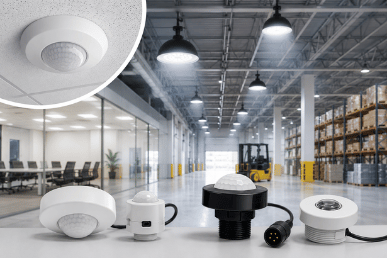
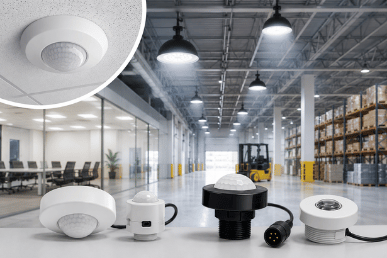
An occupancy sensor is a lighting control device that detects whether people are present in a space. Depending on the lighting system and sensor configuration, it can automatically:
- Turn lights on when occupancy is detected
- Turn lights off after a space becomes vacant
- Dim fixtures during periods of inactivity
- Increase lighting output when movement is detected
- Work alongside daylight harvesting controls
- Integrate with LED lighting control systems
Occupancy sensing is particularly valuable in commercial and industrial buildings because many areas are only occupied intermittently.
Warehouses, storage rooms, offices, conference rooms, restrooms, classrooms, stairwells, corridors, parking structures, and utility spaces are all examples of locations where lights may otherwise remain on even when nobody is using the area.
Modern LED lighting makes occupancy-based control even more practical because LEDs respond immediately to switching and dimming commands.
Occupancy Sensor vs. Motion Sensor: What's the Difference?
The terms occupancy sensor and motion sensor are often used interchangeably, but there can be a slight difference in how the products are applied.
A motion sensor detects movement and triggers a response. Occupancy sensors are specifically designed to determine whether a space is occupied so that building systems—most commonly lighting—can respond appropriately.
For commercial lighting applications, both terms are frequently used to describe sensors that automatically control fixtures based on activity.
There is also an important distinction between occupancy sensors and vacancy sensors.
An occupancy sensor commonly operates as:
Automatic ON → Automatic OFF
A vacancy sensor typically operates as:
Manual ON → Automatic OFF
Vacancy sensing can provide additional energy savings because entering a room doesn't necessarily cause the lights to turn on. This can be useful when daylight already provides enough illumination.
The Three Main Occupancy Sensor Technologies
One of the most important decisions when selecting a sensor is its detection technology. The three most common options for commercial lighting are PIR, ultrasonic, and dual-technology sensors.
1. Passive Infrared (PIR) Occupancy Sensors
Passive infrared occupancy sensors, commonly called PIR sensors, detect changes in infrared energy caused by people moving through their detection area.
PIR technology is extremely common in commercial lighting controls.
Because PIR sensors rely on a field of view, they generally perform best when there is a clear line of sight between the sensor and the occupied area.
PIR sensors are often a good choice for:
- Warehouses
- Warehouse aisles
- Open offices
- Hallways
- Storage rooms
- Utility areas
- Outdoor lighting
- High-bay applications
Their relatively straightforward detection method also makes PIR popular for fixture-mounted and high-bay occupancy sensors.
For example, Beacon Lighting Supply offers the SLG Lighting Fixture-External PIR Motion Sensor with Daylight Harvesting. It includes a built-in high-bay lens designed for mounting heights up to approximately 39 feet, making it an option worth considering for compatible warehouse and industrial lighting systems.
2. Ultrasonic Occupancy Sensors
Ultrasonic sensors work differently. Instead of detecting infrared energy, they emit high-frequency sound waves and monitor changes in the reflected signal.
One major advantage is that ultrasonic technology does not rely on the same direct line of sight as PIR.
That makes it useful for areas containing partitions or other obstacles.
Common ultrasonic sensor applications include:
- Restrooms
- Partitioned offices
- Meeting spaces
- Areas with lower levels of occupant movement
- Rooms with irregular layouts
Ultrasonic sensors can detect relatively small movements, which can help prevent lights from shutting off while someone is sitting relatively still.
The tradeoff is sensitivity. Incorrect placement or configuration can potentially cause unwanted activation, so selecting the appropriate coverage and properly commissioning the sensor is important.
3. Dual-Technology Occupancy Sensors
Dual-technology occupancy sensors combine two sensing methods—commonly PIR and ultrasonic technology.
The goal is to improve occupancy detection while reducing false activation or unwanted shutoffs.
These sensors are especially useful in spaces where occupants may remain relatively stationary for extended periods.
Consider dual-technology sensors for:
- Conference rooms
- Classrooms
- Training rooms
- Large offices
- Meeting spaces
- Complex room layouts
They can cost more than a basic PIR sensor, but the improved detection may justify the additional investment in applications where reliable occupancy sensing is especially important.
Choosing the Right Sensor by Application
Rather than choosing a sensor based only on technology or price, start with the physical environment.
Warehouses and Distribution Centers
Warehouses present unique challenges because of:
- High ceilings
- Tall storage racks
- Long aisles
- Large floor areas
- Intermittent occupancy
- Forklift and employee movement
For these environments, high-bay PIR motion sensors are often a practical solution.
Mounting height is particularly important. A standard office occupancy sensor may not provide the correct detection pattern when installed 25 or 35 feet above the floor.
Look for sensors specifically designed for high-bay LED lighting and verify the rated mounting height and coverage pattern.
Beacon Lighting Supply's SLG Lighting Outdoor PIR Motion Sensor with Daylight Harvesting and 39-Foot High-Bay Lens is designed for compatible high-bay applications and includes PIR occupancy detection along with daylight harvesting capability.
Offices
Private offices can often use wall-switch or ceiling-mounted occupancy sensors.
Open offices may require multiple sensors depending on:
- Square footage
- Furniture placement
- Cubicle walls
- Ceiling height
- Occupant activity
Avoid assuming one sensor will cover an entire office just because its published square-foot coverage appears sufficient. Furniture and partitions can affect actual detection.
Conference Rooms and Classrooms
People in conference rooms and classrooms may remain seated for long periods.
Because of this, reliable detection of smaller movements becomes important. Dual-technology or appropriately selected ultrasonic sensors can be particularly useful in these applications.
Restrooms
Commercial restrooms frequently contain stalls and partitions that interfere with direct line-of-sight detection.
Ultrasonic or dual-technology sensors are often worth considering for these environments, depending on the room layout.
Parking Garages and Similar Areas
Parking structures often operate lighting for extremely long hours despite large portions of the facility being temporarily unoccupied.
Rather than simply switching lighting completely on and off, compatible LED systems can use occupancy detection with bi-level dimming.
For example:
Occupied: 100% light output
Unoccupied: Reduced light output
When movement is detected, fixtures return to the required illumination level.
This approach can reduce unnecessary energy consumption while maintaining baseline illumination.
Pay Attention to Mounting Height and Coverage
Coverage is one of the most overlooked factors when buying an occupancy sensor.
Always review:
- Maximum mounting height
- Detection radius
- Coverage pattern
- Square-foot coverage
- Recommended installation location
- Sensitivity
- Potential obstructions
A sensor's advertised coverage should not be treated as a guarantee that it will detect every occupant anywhere within that area.
The geometry of the space matters.
In warehouses, for example, racks can block PIR detection. Multiple sensors or carefully positioned fixtures may be required to provide reliable aisle coverage.
Look for Sensor-Ready LED Fixtures
If you're planning a new commercial LED lighting installation, sensor-ready fixtures can simplify future control upgrades.
Instead of installing a completely separate control system, compatible sensors can be integrated directly with the fixture or its control interface.
For warehouse applications, consider products such as Beacon Lighting Supply's Westgate Sensor-Ready Digital Beam Angle Linear High Bay.
Sensor-ready fixtures can be especially useful for:
- Warehouses
- Manufacturing facilities
- Distribution centers
- Industrial buildings
- Grocery stores
- Gymnasiums
Planning for controls during the fixture-selection stage can make future lighting automation much easier.
Consider Daylight Harvesting
Occupancy is only one reason lighting output may need to change.
Spaces with windows, skylights, glass entrances, or other natural-light sources can also benefit from daylight harvesting.
Daylight harvesting controls monitor available natural light and adjust electric lighting accordingly.
For example, if sunlight is already providing enough illumination near a window, compatible LED fixtures can automatically dim instead of continuing to operate at full output.
Beacon Lighting Supply offers a Westgate 0-10V Daylight Harvesting Light Sensor for compatible lighting systems.
Combining occupancy sensing and daylight harvesting can create a more comprehensive commercial lighting control strategy.
Check Dimming and Fixture Compatibility
Before purchasing an occupancy sensor, make sure it is compatible with the lighting system it will control.
Important specifications may include:
- Input voltage
- LED driver compatibility
- 0-10V or 1-10V dimming
- Line-voltage vs. low-voltage operation
- Maximum connected load
- Control wiring
- Fixture connector type
- Wireless or wired communication
- Daylight harvesting capabilities
This becomes especially important when sensors are used for bi-level lighting control rather than basic ON/OFF operation.
If your goal is for fixtures to dim to 10%, 20%, or another standby level when an area is vacant, both the sensor/control system and LED driver must support that functionality.
Don't Forget Adjustable Settings
Commercial occupancy sensors may offer adjustable parameters such as:
Time delay: Determines how long lighting remains on after occupancy is no longer detected.
Sensitivity: Changes how much movement is necessary to trigger or maintain occupancy.
Standby dim level: Determines the reduced lighting output when a space is vacant.
Daylight threshold: Prevents lighting from activating when sufficient natural light is available.
These settings allow contractors and facility managers to balance energy savings with occupant comfort.
Setting a delay too short may cause nuisance shutoffs. Setting it unnecessarily long reduces the energy-saving benefit of the control.
Energy Codes and Lighting Rebates
Lighting controls have also become an important part of commercial building energy codes. Requirements vary by jurisdiction and project type, so always verify the applicable local code before specifying equipment.
Occupancy sensors, daylight-responsive controls, automatic shutoff, and dimming controls may be required depending on the building and space.
There is another potential financial benefit: utility rebates.
Some utility energy-efficiency programs provide incentives for lighting controls, including:
- Occupancy sensors
- Motion sensors
- Daylight harvesting controls
- Networked lighting controls
- LED fixtures with integrated controls
If you're planning a large commercial LED retrofit, check available rebate programs before purchasing equipment. Some programs require pre-approval before installation.
Occupancy Sensor Buying Checklist
Before ordering a commercial occupancy sensor, confirm:
- Application – Office, restroom, classroom, warehouse, parking garage, etc.
- Detection technology – PIR, ultrasonic, or dual technology.
- Mounting height – Especially important for high-bay lighting.
- Coverage area – Match the detection pattern to the actual room.
- Mounting style – Wall, ceiling, fixture-mounted, or integrated.
- Voltage – Verify electrical compatibility.
- Dimming compatibility – Determine whether 0-10V or another control method is required.
- Time-delay settings – Look for appropriate adjustability.
- Daylight harvesting – Consider whether photocontrol functionality would improve savings.
- Environment – Confirm indoor, outdoor, damp-location, or other ratings as necessary.
- Fixture compatibility – Verify connectors, drivers, and sensor-ready requirements.
- Energy-code requirements – Check applicable state and local codes.
Build a Smarter Commercial Lighting System
The best occupancy sensor isn't necessarily the most expensive or sophisticated option. It's the sensor that matches the way people actually use the space.
A straightforward PIR sensor may be ideal for a warehouse aisle, while a conference room may benefit from dual-technology detection. A high-bay facility needs a sensor designed for its mounting height, while an office with abundant natural light may benefit from combining occupancy sensing with daylight harvesting.
Taking the time to evaluate sensor technology, coverage, mounting height, LED compatibility, dimming, and application requirements can help create a lighting system that is more efficient, reliable, and comfortable.
Whether you're upgrading a single room or planning controls for an entire commercial facility, Beacon Lighting Supply can help you find the right lighting products and controls for your application.
Shop commercial lighting and lighting solutions at Beacon Lighting Supply or contact our team for assistance with larger commercial and industrial lighting projects.