

Beacon Lighting Supply | Lighting the Way
LED Strip Lights vs. Linear Fixtures: What's the Difference?
When selecting lighting for a commercial or industrial facility, choosing the right fixture can make a significant difference in energy efficiency, visibility, installation costs, and overall lighting performance.
Two popular options for commercial indoor lighting are LED strip lights and linear LED fixtures. Both offer energy-efficient illumination, long service life, and versatility across a wide range of applications. However, understanding their differences can help facility managers, electrical contractors, and business owners make more informed lighting decisions.
Although these fixtures may look similar, they can differ in design, light distribution, installation methods, and intended applications.
So, when comparing LED strip lights vs. linear fixtures, which option is best for your facility?
Let's take a closer look.
What Are Commercial LED Strip Lights?
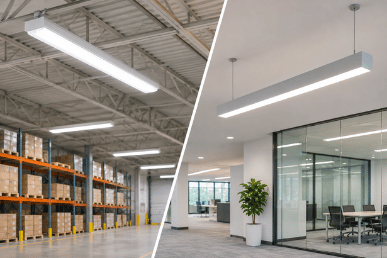
Commercial LED strip lights are elongated lighting fixtures designed to provide efficient, uniform illumination in industrial, commercial, and utility environments.
Unlike flexible LED tape lights commonly used for decorative or accent lighting, commercial LED strip fixtures are rigid luminaires designed for permanent installation.
These fixtures typically feature a narrow housing containing integrated LED components or replaceable LED lamps, depending on the design.
LED strip lights are commonly available in 2-foot, 4-foot, and 8-foot configurations, making them suitable for various ceiling heights and room dimensions.
Common Applications for LED Strip Lights
Commercial LED strip fixtures are frequently installed in:
-
Warehouses and storage facilities
-
Utility rooms and mechanical spaces
-
Commercial corridors and stairwells
-
Workshops and maintenance areas
-
Parking garages with suitable environmental ratings
-
Retail stockrooms
-
Manufacturing facilities
-
Commercial kitchens and service areas where appropriately rated
One of the biggest advantages of LED strip lighting is its straightforward, functional design.
These fixtures provide dependable general illumination without requiring elaborate housings or decorative finishes.
For businesses upgrading outdated fluorescent lighting systems, LED strip fixtures can offer an efficient replacement while maintaining a familiar lighting layout.
Explore LED Strip Lighting at Beacon Lighting Supply:
Browse our selection of 4-foot LED strip lights and 8-foot LED strip lights for commercial and industrial applications.
What Are Linear LED Fixtures?
Linear LED fixtures are lighting systems characterized by their elongated design and ability to provide consistent illumination across a defined area.
While commercial LED strip lights are technically a type of linear lighting, the term linear LED fixtures often refers to a broader category that includes architectural, suspended, recessed, and surface-mounted luminaires.
These fixtures are frequently selected for projects requiring both lighting performance and a more refined appearance.
Depending on the model, linear LED lighting systems may incorporate diffused lenses, specialized optics, modular connections, or continuous-row configurations.
Common Applications for Linear LED Lighting
Linear LED fixtures are commonly used in:
-
Corporate offices and conference rooms
-
Educational facilities
-
Healthcare environments
-
Retail stores and showrooms
-
Commercial hallways
-
Hospitality spaces
-
Architectural lighting installations
-
Modern commercial interiors
Many linear lighting systems can be installed in continuous rows, creating uninterrupted lines of illumination across ceilings or workspaces.
This makes them particularly useful in commercial environments where visual consistency and lighting design are important.
Linear fixtures may also offer greater flexibility in mounting configurations, including suspended, recessed, and surface-mounted installations.
Explore Linear Lighting at Beacon Lighting Supply:
Discover our selection of commercial linear LED lighting fixtures for new construction, renovations, and commercial lighting upgrades.
LED Strip Lights vs. Linear Fixtures: Key Differences
Although these two lighting categories overlap, several characteristics can help distinguish them.
|
Feature |
LED Strip Fixtures |
Linear LED Fixtures |
|---|---|---|
|
Primary purpose |
Functional general lighting |
General and architectural lighting |
|
Appearance |
Simple, utilitarian |
Functional to decorative |
|
Installation |
Commonly surface-mounted or suspended |
Surface, suspended, or recessed |
|
Light distribution |
Often broad, diffuse illumination |
Varies by optics and design |
|
Typical cost |
Often more economical |
Varies widely; architectural models may cost more |
|
Continuous rows |
Available on select models |
Common in modular systems |
|
Common applications |
Warehouses, utility areas, storage |
Offices, retail, corridors, commercial interiors |
The important distinction is that LED strip fixtures are a subset of linear lighting, rather than an entirely separate lighting technology.
The best choice depends on the specific fixture design and the requirements of the installation.
1. Fixture Design and Appearance
One of the most noticeable differences between LED strip lights and architectural linear fixtures is their physical appearance.
LED strip fixtures generally prioritize practicality. Their narrow housings are designed to deliver effective illumination while keeping installation and material costs manageable.
This makes them ideal for areas where appearance is less important than performance.
For example, a commercial storage room may benefit from simple LED strip fixtures that provide consistent lighting across shelving and work areas.
Architectural linear fixtures, on the other hand, may feature sleek housings, seamless diffusers, and specialized mounting options.
These characteristics make them popular in office buildings, retail environments, and other customer-facing commercial spaces.
However, appearance alone should not determine fixture selection.
Light output, energy efficiency, and application requirements remain equally important.
2. Light Distribution and Performance
Both LED strip lights and linear LED fixtures can deliver excellent lighting performance, but their light distribution characteristics depend on the fixture's optical design.
Commercial LED strip lights commonly use diffused lenses to distribute illumination across a relatively broad area.
This helps provide consistent visibility in warehouses, utility rooms, and general-purpose commercial spaces.
Linear LED fixtures may offer additional optical configurations, including direct, indirect, or combined direct/indirect illumination.
Some models are designed to reduce glare or distribute light more precisely across workstations and architectural spaces.
When comparing fixtures, consider:
-
Lumens: The total amount of visible light produced.
-
Lumens per watt: A measurement of energy efficiency.
-
Beam distribution: How illumination spreads throughout the space.
-
Color temperature (CCT): The appearance of the light, measured in Kelvin.
-
Color Rendering Index (CRI): How accurately colors appear under the light.
-
Glare control: The fixture's ability to minimize uncomfortable brightness.
For commercial lighting projects, evaluating these specifications is more useful than comparing fixture wattage alone.
3. Installation and Mounting Options
Installation requirements can significantly influence the overall cost of a commercial lighting project.
LED strip fixtures are commonly designed for straightforward surface mounting, although suspended installation options are available on certain models.
Their simple construction can make them practical for replacing older fluorescent strip fixtures.
Some products also offer retrofit configurations that allow existing housings to be upgraded without replacing the entire lighting assembly.
Architectural linear LED fixtures may require additional planning, particularly when installing recessed systems or continuous lighting runs.
Depending on the design, installation may involve specialized mounting hardware, suspension cables, connectors, or ceiling modifications.
For new construction projects, these requirements can often be incorporated into the original lighting plan.
For retrofit projects, however, installation complexity should be evaluated alongside fixture cost.
4. Energy Efficiency and Operating Costs
Energy efficiency is one of the primary reasons businesses transition from fluorescent lighting to LED technology.
Both commercial LED strip lights and linear LED fixtures can provide significant energy savings compared with older lighting systems.
Modern LED fixtures generally consume less electricity while delivering comparable or improved light output.
For example, replacing an older fluorescent fixture consuming 96 watts with a 40-watt LED fixture reduces power consumption by approximately 58%.
Actual savings depend on the existing lighting system, operating hours, and replacement fixture.
Additional energy savings may be possible through lighting controls such as:
-
Occupancy and motion sensors
-
Daylight harvesting systems
-
0–10V dimming
-
Programmable lighting schedules
-
Networked lighting controls
Facilities operating lighting for extended hours may see particularly meaningful reductions in electricity consumption.
Both strip and linear fixtures are available with advanced control capabilities, although compatibility varies by model.
5. Cost and Long-Term Value
Initial fixture pricing is another consideration when comparing commercial LED lighting options.
Standard LED strip fixtures are often more affordable than architectural linear lighting systems.
Their relatively simple construction makes them attractive for large-scale installations where dozens or hundreds of fixtures may be required.
Architectural linear fixtures may carry higher upfront costs because of their housing designs, specialized optics, or mounting systems.
However, these features can provide additional value in environments where aesthetics, glare control, and occupant comfort are priorities.
When evaluating lighting costs, businesses should consider more than the purchase price.
Total cost of ownership includes fixture pricing, installation labor, electricity consumption, maintenance requirements, and expected service life.
A properly selected LED lighting system can reduce long-term operating expenses while improving the quality of illumination throughout a facility.
6. Choosing the Right Lighting for Your Facility
Selecting between LED strip fixtures and other linear LED lighting systems ultimately depends on how the space will be used.
When to Choose LED Strip Lights
LED strip fixtures are an excellent choice when your priorities include:
-
Cost-effective general illumination
-
Simple installation and maintenance
-
Replacing outdated fluorescent fixtures
-
Lighting warehouses, storage rooms, and utility spaces
-
Providing dependable illumination across large areas
For example, the Aleo Lighting LLS 4-Foot Linear LED Strip offers selectable wattages of 25W, 30W, and 40W, along with adjustable color temperatures of 3500K, 4000K, and 5000K.
These adjustable settings allow contractors and facility managers to tailor lighting performance to the installation.
When to Choose Architectural Linear LED Fixtures
Architectural linear lighting may be preferable when your project requires:
-
A modern, streamlined appearance
-
Suspended or recessed lighting installations
-
Continuous rows of illumination
-
Specialized optical distributions
-
A combination of functional and decorative lighting
For office renovations, retail environments, and modern commercial interiors, architectural linear fixtures can provide effective illumination while complementing the overall design.
Can LED Strip Lights Replace Fluorescent Fixtures?
Yes. LED strip fixtures are frequently used in commercial lighting retrofit projects to replace older fluorescent lighting systems.
Many commercial facilities still rely on traditional fluorescent strip fixtures that consume more electricity and require periodic lamp replacements.
Upgrading to LED strip lighting can provide several advantages, including improved energy efficiency, reduced maintenance requirements, and better lighting consistency.
Depending on the existing installation, contractors may choose between replacing the complete fixture or installing a compatible LED retrofit kit.
For example, Beacon Lighting Supply offers the Aleo Lighting LSX 4-Foot Super Slim Linear LED Strip, featuring selectable wattage options and a slim fixture design suitable for commercial lighting projects.
Before upgrading, verify the existing electrical configuration, mounting requirements, and desired light output to ensure proper fixture compatibility.
Frequently Asked Questions
Are LED strip lights considered linear lighting?
Yes. Commercial LED strip fixtures are a type of linear lighting because of their elongated shape and lighting distribution. However, the broader linear lighting category also includes architectural, recessed, suspended, and other specialized fixtures.
Are LED strip fixtures good for warehouses?
Yes. LED strip fixtures are commonly used in warehouses, stockrooms, and storage facilities, particularly where ceiling heights and required light levels make them appropriate. Facilities with high ceilings may benefit more from dedicated LED high bay lighting.
Which is more energy efficient: LED strip lights or linear fixtures?
Neither category is automatically more efficient. Energy efficiency depends on the individual fixture's lumen output, wattage, driver efficiency, and optical design. Comparing lumens per watt is a useful starting point.
Can linear LED fixtures be dimmed?
Many commercial linear LED fixtures support dimming technologies such as 0–10V dimming. However, dimming compatibility varies by manufacturer and model, so specifications should be verified before installation.
Find the Right Commercial LED Lighting at Beacon Lighting Supply
Whether you're upgrading warehouse lighting, replacing outdated fluorescent fixtures, or planning a new commercial installation, selecting the right LED lighting system is essential for long-term performance and efficiency.
Both LED strip lights and architectural linear fixtures offer advantages depending on your facility's layout, lighting requirements, and budget.
At Beacon Lighting Supply, we offer a wide selection of commercial and industrial LED lighting solutions designed to meet the needs of electrical contractors, facility managers, and business owners.
Explore our LED strip lighting options and linear LED fixtures to find the right products for your next project.
Not sure which fixture is right for your application? Our team can help you compare lighting options and select products that meet your performance requirements, installation needs, and budget.
Visit Beacon Lighting Supply to explore our commercial LED lighting solutions.