
Beacon Lighting Supply | Lighting the Way
How Many High Bay Lights Do I Need? A Warehouse Lighting Guide
Determining how many high bay lights you need for a warehouse isn't as simple as dividing the building's square footage by the coverage of a single fixture.
Two warehouses with the exact same square footage can require very different lighting layouts depending on ceiling height, aisle configuration, fixture lumen output, mounting height, and the type of work being performed.
Installing too few high bay lights can create dark spots, uneven illumination, and poor visibility. Installing too many can lead to excessive brightness, glare, and unnecessary energy costs.
So, how many high bay lights do you need for a warehouse?
The best answer comes from considering several factors together: square footage, desired foot-candle levels, fixture lumen output, mounting height, spacing, beam angle, and the physical layout of the facility.
This guide walks through the process and provides a practical starting point for planning an LED warehouse lighting layout.
What Are High Bay Lights?
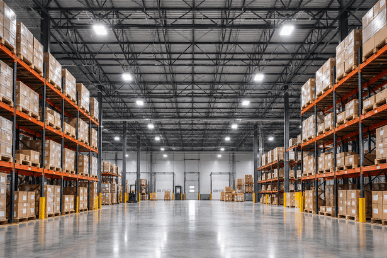
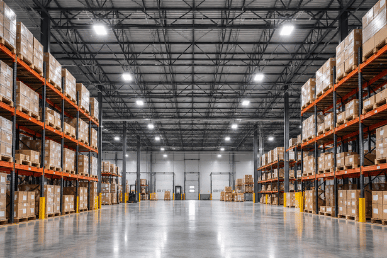
LED high bay lights are high-output commercial and industrial fixtures designed to illuminate spaces with elevated ceilings. They are commonly used in:
-
Warehouses
-
Distribution centers
-
Manufacturing facilities
-
Factories
-
Workshops
-
Aircraft hangars
-
Gymnasiums
-
Large retail facilities
-
Storage buildings
High bay fixtures produce enough light to maintain useful illumination at floor and work-surface level even when the fixture is mounted well above the space.
Modern LED high bays also offer significant advantages over older metal halide, HID, and fluorescent systems, including improved energy efficiency, longer operating life, instant-on performance, dimming capabilities, and compatibility with occupancy sensors and other lighting controls.
Beacon Lighting Supply offers a variety of commercial and industrial lighting solutions for warehouse and high-ceiling applications.
Why Square Footage Alone Doesn't Tell You How Many Lights You Need
It's tempting to search for something like "how many high bay lights for a 10,000-square-foot warehouse" and expect a single number.
Unfortunately, square footage is only one piece of the equation.
Consider two 10,000-square-foot warehouses.
One has an 18-foot ceiling with open bulk storage. The other has a 30-foot ceiling filled with tall pallet racks and active picking aisles.
Even though their floor areas are identical, they may require completely different fixture outputs, optics, spacing, and quantities.
Before calculating your warehouse high bay light quantity, consider:
-
Warehouse dimensions
-
Mounting height
-
Required foot-candle level
-
Fixture lumen output
-
Beam angle
-
Rack and aisle configuration
-
Surface reflectivity
-
Equipment and other obstructions
-
Type of work performed
-
Required lighting uniformity
Understanding these factors will give you a much more accurate starting point.
Step 1: Calculate Your Warehouse Square Footage
Start by determining the area that needs to be illuminated.
For a rectangular space:
Length × Width = Square Footage
For example, a warehouse measuring 100 feet by 100 feet contains:
100 × 100 = 10,000 square feet
If your warehouse has several distinct areas, calculate them separately.
This is especially important when a facility contains open storage, rack aisles, packing stations, loading areas, and manufacturing spaces. Each zone may have different lighting requirements.
Step 2: Determine the Required Foot-Candle Level
A foot-candle measures how much light reaches a surface. One foot-candle equals one lumen of light per square foot.
This is an important distinction because the lumen rating printed on a fixture tells you how much light the fixture produces—not necessarily how much useful light reaches the warehouse floor or work surface.
Different warehouse activities require different illumination levels.
As a general planning guideline, bulk or low-activity storage areas may require approximately 10–20 foot-candles, while active warehouse aisles may need around 20–30 foot-candles. Packing, staging, shipping, and other more visually demanding tasks may call for approximately 30–50 foot-candles.
Detailed inspection or specialized manufacturing tasks may require still higher illumination.
These ranges are starting points rather than universal requirements. The appropriate level depends on the work being performed, applicable standards, facility conditions, and the location where illumination is measured.
Step 3: Estimate the Total Lumens Required
Once you know the square footage and your target foot-candle level, you can estimate the amount of light required.
A basic calculation is:
Square Footage × Target Foot-Candles = Required Lumens at the Work Plane
Suppose you have a 10,000-square-foot warehouse and want an average of 30 foot-candles.
10,000 × 30 = 300,000 lumens
At first glance, it might seem like you could simply divide 300,000 by the lumen output of your chosen high bay.
But there's another important consideration.
Not every lumen produced by the fixture reaches the work plane.
Fixture optics, mounting height, room geometry, surface reflectance, dirt accumulation, aging, racking, and other factors affect how much light ultimately reaches the target area.
Professional lighting calculations account for these losses through factors such as coefficient of utilization (CU) and light loss factor (LLF).
A more realistic formula is:
Number of Fixtures = (Area × Target Foot-Candles) ÷ (Lumens per Fixture × CU × LLF)
This is why a simple lumens-per-square-foot calculation should be considered an estimate rather than a final warehouse lighting design.
Step 4: Consider Ceiling and Mounting Height
The distance between your high bay fixtures and the work surface can dramatically affect the lighting layout.
As mounting height increases, light has farther to travel and spreads over a larger area.
A fixture that performs well at 18 feet may not provide the same illumination when installed at 35 feet.
Higher mounting heights may require:
-
Greater lumen output
-
Different beam angles
-
Different fixture spacing
-
More carefully controlled optics
The actual mounting height matters more than simply knowing the building's ceiling height.
If the ceiling is 30 feet high but the fixtures are suspended at 25 feet, your lighting calculations should be based on the actual fixture location.
Step 5: Choose the Right High Bay Fixture
Once you understand your lighting requirements, you can begin selecting fixtures.
Two of the most common options are UFO LED high bays and linear LED high bays.
UFO high bays have a compact, circular design and typically provide broad, symmetrical illumination. They can be an excellent option for open warehouses, manufacturing floors, loading areas, workshops, and other large unobstructed spaces.
Linear high bays have a longer rectangular shape and can distribute light along aisles, shelving rows, production lines, and other structured spaces.
If you're deciding between the two styles, read our complete guide: UFO vs. Linear High Bay Lights: Which Is Better for Your Facility?
The best fixture isn't necessarily the one with the highest wattage or lumen output. It's the fixture that delivers the appropriate amount of usable light where you need it.
Step 6: Plan High Bay Light Spacing
Fixture spacing is just as important as fixture quantity.
If high bay lights are spaced too far apart, the warehouse may develop alternating bright and dark areas. If they're installed too close together, you can end up with excessive overlap, glare, and unnecessary energy consumption.
Proper spacing depends on:
-
Mounting height
-
Beam angle
-
Fixture lumen output
-
Fixture optics
-
Target foot-candles
-
Warehouse layout
-
Desired uniformity
For example, an open warehouse may allow fixtures to be arranged in a relatively consistent grid.
A racked warehouse is different.
Instead of simply creating a grid based on square footage, fixtures may need to align with aisles so light reaches both the floor and the vertical surfaces of storage racks.
This is one reason warehouse lighting design should consider the building's actual layout rather than relying solely on a fixture-count calculator.
Example: How Many High Bay Lights for a 10,000-Square-Foot Warehouse?
Let's look at a simplified example.
Suppose your facility has:
Warehouse area: 10,000 sq. ft.
Target illumination: 30 foot-candles
LED high bay output: 20,000 lumens per fixture
Your initial lumen requirement would be:
10,000 × 30 = 300,000 lumens
Dividing by 20,000 lumens per fixture gives:
300,000 ÷ 20,000 = 15 fixtures
But does that mean you should install exactly 15 high bays?
Not necessarily.
That calculation assumes every lumen produced reaches the work surface—which doesn't happen in a real warehouse.
Once mounting height, fixture distribution, light loss, coefficient of utilization, racks, equipment, and uniformity are considered, the required fixture count may be higher.
That's why the basic calculation is useful for budgeting and preliminary planning, while a photometric layout is much more useful for determining a final fixture count and placement.
Don't Forget Warehouse Racking
Warehouse racking can dramatically change a lighting plan.
In an open warehouse, the primary goal may be even horizontal illumination across the floor.
In a high-rack warehouse, employees and forklift operators also need to see:
-
Product labels
-
Shelf locations
-
Pallet contents
-
Rack faces
-
Inventory at different heights
This makes vertical illumination important.
Placing fixtures directly over racks can also waste light because the shelving itself may block much of the illumination.
For warehouses with long pallet aisles, linear high bays or fixtures equipped with aisle-oriented optics can help direct light where workers actually need it.
Can You Replace Metal Halide High Bays One-for-One With LED?
Sometimes—but don't assume you should.
When replacing older metal halide or fluorescent warehouse fixtures, it can be tempting to install one LED fixture at every existing mounting point.
That approach is convenient, but it may not create the most efficient LED lighting layout.
Modern LED high bays can offer different lumen outputs, beam patterns, and optical distributions than the fixtures they're replacing.
A redesigned layout may allow you to:
-
Reduce fixture count
-
Improve uniformity
-
Reduce energy consumption
-
Eliminate dark spots
-
Improve aisle visibility
-
Add occupancy controls
-
Improve overall lighting quality
Evaluate the actual lighting needs of the facility instead of automatically duplicating the old layout.
Use Controls to Reduce Warehouse Lighting Costs
Fixture selection isn't the only opportunity to improve efficiency.
Warehouses are especially well suited for lighting controls because many areas aren't occupied continuously.
Consider using:
Occupancy sensors: Lights can automatically dim or turn off when an aisle or area isn't being used.
Daylight harvesting: Areas with skylights or other natural light sources can reduce artificial lighting output when sufficient daylight is available.
0–10V dimming: Compatible LED high bays can be adjusted to maintain appropriate light levels without operating at full output unnecessarily.
Selectable wattage fixtures: Wattage-selectable high bays provide additional flexibility during installation and allow output to be adjusted for different areas of the facility.
Over thousands of annual operating hours, these strategies can significantly reduce unnecessary energy use.
Why a Photometric Lighting Layout Matters
For smaller projects, general calculations may provide enough information to begin comparing fixtures.
For large warehouses, distribution centers, manufacturing plants, or facilities with complex racking, a photometric lighting layout is one of the best ways to determine how many high bay lights you actually need.
Photometric planning can model:
-
Fixture quantity
-
Fixture locations
-
Mounting height
-
Average foot-candle levels
-
Minimum and maximum light levels
-
Uniformity
-
Beam distribution
-
Dark spots
-
Rack and aisle illumination
Instead of guessing whether 20, 30, or 40 fixtures will work, you can evaluate the expected lighting performance before installation.
That can help prevent the expensive mistake of installing an entire warehouse lighting system only to discover that certain areas are too dark—or unnecessarily bright.
How Many LED High Bay Lights Do You Really Need?
There isn't a universal number of high bay lights per square foot.
The correct fixture count depends on the relationship between warehouse size, mounting height, target foot-candles, lumen output, optics, fixture spacing, and facility layout.
A simple lumen calculation can provide a useful starting point:
Area × Target Foot-Candles = Initial Lumen Requirement
But your final lighting design should also account for real-world light losses, fixture distribution, obstructions, racking, and uniformity.
The goal isn't simply to install enough fixtures.
It's to put the right amount of light in the right places while controlling energy use and maintaining comfortable, consistent illumination.
Find LED High Bay Lighting for Your Warehouse
Whether you're upgrading outdated metal halide fixtures, designing a new warehouse, or improving lighting in an existing industrial facility, Beacon Lighting Supply can help you find commercial LED high bay lighting that fits your application.
From UFO high bays for open spaces to linear high bays for warehouse aisles and structured layouts, we offer commercial and industrial lighting solutions for a wide range of facility types.
Shop Beacon Lighting Supply or contact our team for help comparing high bay fixtures for your project.