
Beacon Lighting Supply | Lighting the Way
Electrical Conduit Types Explained: A Guide for Commercial Lighting & Electrical Projects
When planning a commercial lighting or electrical installation, much of the attention naturally goes toward fixtures, controls, voltage, and energy efficiency. But there is another important part of the electrical system working behind the scenes: electrical conduit.
Electrical conduit and other raceway systems help route and protect electrical wiring throughout a building or property. From office lighting installations to warehouses, parking lots, retail spaces, and industrial facilities, choosing the appropriate raceway can help protect conductors from physical damage, moisture, corrosion, and other environmental conditions.
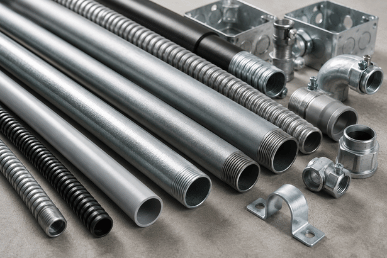
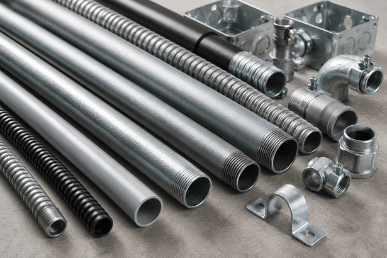
However, not all conduit is the same. EMT, RMC, IMC, FMC, LFMC, PVC, and LFNC each have characteristics that make them better suited to certain environments and applications.
In this guide, we'll explain the most common electrical conduit types, where they're typically used, and what contractors and facility managers should consider when selecting a raceway for a commercial electrical or lighting project.
What Is Electrical Conduit?
Electrical conduit is a type of raceway used to route and protect electrical conductors. Raceways provide an enclosed pathway through which wires can be installed between electrical panels, junction boxes, lighting fixtures, equipment, controls, and other electrical components.
While the terms conduit and raceway are sometimes used interchangeably in everyday conversation, conduit is actually one family of raceway systems. For example, Electrical Metallic Tubing (EMT) is technically tubing rather than conduit, although it is commonly grouped with conduit products in the electrical industry.
Depending on the installation, an electrical raceway can help:
- Protect wiring from physical damage
- Organize and route electrical conductors
- Protect wiring in wet or corrosive environments
- Make future wiring changes easier
- Support safe commercial electrical installations
- Provide a professional, organized finished installation
Raceway selection becomes especially important when installing commercial lighting systems, where wiring may travel through ceilings, walls, warehouses, mechanical spaces, exterior areas, and underground locations.
1. Electrical Metallic Tubing (EMT)
Electrical Metallic Tubing, commonly called EMT conduit or "thin-wall," is one of the most recognizable raceways used in commercial electrical installations.
EMT is relatively lightweight and has a thinner wall than heavier metal conduit options. Unlike RMC and IMC, EMT isn't threaded. Instead, sections are typically joined using set-screw or compression fittings.
Common EMT Applications
EMT is frequently found in:
- Commercial office buildings
- Retail stores
- Schools
- Warehouses
- Interior lighting installations
- Exposed electrical systems
- Utility and mechanical areas
Because EMT is relatively easy to bend and install, it is a popular option for commercial projects requiring long runs of electrical raceway.
For example, an electrician installing new LED high bay lighting throughout a warehouse might use EMT to route branch-circuit wiring between fixtures, junction boxes, and electrical panels.
Looking for components for your next installation? Browse the Electrical Supplies section at Beacon Lighting Supply.
2. Rigid Metal Conduit (RMC)
Rigid Metal Conduit, or RMC, provides substantially more physical protection than thin-wall raceways such as EMT.
RMC has thick walls and threaded connections, making it suitable for installations where wiring may face greater risk of physical damage or exposure to demanding environmental conditions.
Common RMC Applications
RMC may be used for:
- Industrial facilities
- Manufacturing plants
- Exterior electrical installations
- Service entrances
- Areas exposed to physical damage
- Certain underground applications
- Demanding commercial environments
The added protection comes with tradeoffs. RMC is heavier and generally requires more labor to cut, bend, thread, and install than EMT.
For projects where durability is more important than ease of installation, however, RMC can be an excellent solution.
3. Intermediate Metal Conduit (IMC)
Intermediate Metal Conduit, or IMC, falls between EMT and RMC in terms of construction.
Like RMC, IMC is a threaded metal raceway. However, IMC has a thinner wall and is lighter than RMC while still providing significant physical protection.
Common IMC Applications
IMC can be found in:
- Commercial buildings
- Industrial facilities
- Outdoor installations
- Exposed electrical systems
- Areas requiring additional mechanical protection
For contractors, IMC can provide a useful balance between the strength associated with rigid conduit and a lighter overall installation.
4. Flexible Metal Conduit (FMC)
Not every electrical connection should be completely rigid.
Flexible Metal Conduit, commonly abbreviated FMC and sometimes called "flex," is manufactured from an interlocked metal strip that allows the raceway to bend.
This flexibility makes FMC particularly useful for connecting equipment where movement, alignment, or vibration would make rigid raceway difficult to install.
Common FMC Applications
FMC may be used for connections to:
- Lighting fixtures
- Motors
- HVAC equipment
- Machinery
- Transformers
- Equipment subject to vibration
In commercial lighting installations, short sections of flexible conduit can make final fixture connections significantly easier, particularly where precise alignment with a rigid raceway would be inconvenient.
FMC generally isn't selected because it is stronger than rigid conduit. Its primary advantage is exactly what its name suggests: flexibility.
5. Liquidtight Flexible Metal Conduit (LFMC)
What happens when you need the flexibility of FMC but also need additional protection against moisture?
That's where Liquidtight Flexible Metal Conduit, or LFMC, comes in.
LFMC combines a flexible metallic construction with an outer liquidtight jacket. This makes it useful for equipment connections in locations where moisture, liquids, or certain environmental contaminants are concerns.
Common LFMC Applications
LFMC is often used around:
- Outdoor equipment
- HVAC units
- Pumps
- Motors
- Industrial machinery
- Wet or damp locations
- Exterior lighting equipment
For commercial exterior lighting projects, liquidtight connections may be especially useful around equipment or fixtures exposed to weather.
Browse commercial outdoor lighting solutions from Beacon Lighting Supply.
6. Rigid PVC Conduit
Metal isn't always the best choice.
Rigid PVC conduit is a nonmetallic raceway valued for its lightweight construction and resistance to corrosion and moisture.
Because PVC doesn't rust like steel, it is commonly used for underground installations and in environments where corrosion is a concern.
Common PVC Conduit Applications
PVC conduit is frequently used for:
- Underground electrical runs
- Outdoor lighting projects
- Landscape lighting infrastructure
- Parking lot lighting
- Certain wet locations
- Corrosive environments
One important consideration is that PVC expands and contracts as temperatures change. Proper installation methods and expansion provisions may therefore be necessary, depending on the application.
PVC also doesn't provide the same physical strength or grounding characteristics as metallic raceways, so installers need to evaluate the entire electrical system rather than selecting conduit based on cost alone.
For outdoor electrical installations, Beacon Lighting Supply also carries weatherproof boxes and electrical supplies.
7. Liquidtight Flexible Nonmetallic Conduit (LFNC)
Liquidtight Flexible Nonmetallic Conduit, or LFNC, offers flexibility and moisture resistance without metallic construction.
It can be useful where equipment requires a flexible connection and the installation environment calls for a nonmetallic raceway.
Typical applications can include certain:
- Outdoor electrical connections
- HVAC equipment
- Motors
- Pumps
- Lighting systems
- Wet-location installations
As with every conduit type, the specific product must be listed and approved for the intended application.
Metal vs. Nonmetallic Conduit: Which Is Better?
There isn't one electrical conduit that's best for every project.
Metallic raceways such as EMT, IMC, and RMC provide excellent mechanical protection and may also play a role in equipment grounding when installed according to applicable requirements.
Nonmetallic raceways such as PVC offer excellent corrosion resistance and can be easier to handle and install.
The right choice depends on the environment.
A contractor running circuits through the interior of a commercial building may select EMT, while underground wiring feeding parking lot lighting could call for PVC. A connection to vibrating equipment might require FMC or LFMC instead.
The goal isn't to choose the "best" conduit overall. It's to choose the right electrical raceway for the specific installation.
Choosing Conduit for Commercial Lighting
Commercial lighting projects often require several different wiring methods within the same facility.
Consider a warehouse lighting upgrade.
Electrical wiring might travel through EMT across the interior structure before transitioning to flexible conduit near certain fixtures. Outdoor circuits feeding wall packs or area lights could require raceways and fittings rated for the environmental conditions they encounter.
That's why conduit selection should consider the entire lighting installation rather than individual fixtures alone.
When planning your project, evaluate:
Location: Is the installation indoors, outdoors, underground, wet, dry, or corrosive?
Physical protection: Could the raceway be struck by equipment, tools, vehicles, or machinery?
Moisture exposure: Will the installation encounter rain, washdown conditions, condensation, or other liquids?
Flexibility: Does the connected equipment move or vibrate?
Corrosion: Will chemicals, salt, moisture, or environmental conditions attack metallic materials?
Installation requirements: How difficult will the raceway be to cut, bend, support, and connect?
Code requirements: Is the selected wiring method permitted for the specific location and application?
Don't Forget Conduit Fittings
Choosing the correct conduit is only part of the installation.
Electrical raceway systems also rely on appropriate conduit fittings and electrical accessories to create secure connections.
Depending on the raceway, these may include:
- Connectors
- Couplings
- Bushings
- Locknuts
- Conduit bodies
- Straps and supports
- Weatherproof fittings
- Junction boxes
Fittings should be compatible with both the conduit type and the environment where they are installed.
Browse electrical fittings and supplies at Beacon Lighting Supply.
Electrical Conduit and LED Lighting Upgrades
Conduit deserves particular attention when upgrading older commercial lighting systems.
An LED retrofit may involve more than simply replacing fixtures. Contractors may need to reroute circuits, install new controls, relocate junction boxes, add occupancy sensors, or modify wiring to accommodate a redesigned lighting layout.
Before beginning an LED lighting upgrade, inspect the existing electrical infrastructure along with the fixtures themselves.
Look for issues such as:
- Damaged raceways
- Corrosion
- Loose or damaged fittings
- Improperly supported conduit
- Deteriorated boxes
- Wiring that needs replacement
- Raceway systems unsuitable for the new installation environment
Addressing electrical infrastructure at the same time as a lighting retrofit can help create a safer, cleaner, and more dependable finished project.
Browse Commercial Lighting from Beacon Lighting Supply.
Always Follow Electrical Codes and Manufacturer Requirements
Electrical conduit installation isn't a one-size-fits-all process.
The National Electrical Code (NEC), local codes, product listings, manufacturer instructions, and the authority having jurisdiction can all affect which wiring methods are permitted.
Requirements can vary based on factors such as:
- Wet or dry locations
- Corrosive environments
- Hazardous locations
- Burial depth
- Temperature
- Conductor fill
- Grounding and bonding
- Support and fastening
- Bend limits
- Physical protection
Electrical work should always be performed in accordance with applicable codes and by qualified professionals where required.
Choosing the Right Electrical Conduit for Your Project
Understanding the differences between EMT, RMC, IMC, FMC, LFMC, PVC, and LFNC conduit makes it easier to plan commercial electrical and lighting projects.
For many interior commercial installations, EMT provides an effective combination of durability and ease of installation. RMC and IMC provide greater mechanical protection for demanding environments, while FMC and LFMC add flexibility for equipment connections. PVC provides a lightweight, corrosion-resistant solution that is commonly used for underground and outdoor applications.
Ultimately, selecting the correct conduit means considering where the wiring will be installed, what conditions it will face, and how much physical and environmental protection it requires.
And when it's time to complete the rest of your electrical or commercial lighting project, Beacon Lighting Supply is here to help.
Explore electrical supplies, fittings, cables, controls, weatherproof boxes, commercial LED lighting, and more at: