
Beacon Lighting Supply | Lighting the Way
LED Loading Dock Lights: Choosing the Right Fixtures for Warehouse Operations
Loading docks are among the busiest and most demanding areas of any warehouse or distribution center. From early morning deliveries to overnight shipping operations, these spaces require dependable lighting to keep employees, equipment, and shipments moving efficiently.
Poor lighting can create unnecessary challenges during loading and unloading. Dark trailer interiors, uneven illumination, and shadows around dock doors can make it difficult for workers to identify obstacles, read labels, and safely operate material-handling equipment.
That's where LED loading dock lights come in.
Modern commercial loading dock lighting provides focused illumination, improved energy efficiency, and reliable performance in demanding industrial environments. However, choosing the right fixtures involves more than simply selecting the brightest option.
In this guide, we'll explore the different types of LED dock lights, important specifications, installation considerations, and how to choose the best lighting solutions for your warehouse operations.
Why Proper Loading Dock Lighting Matters
Loading docks present unique lighting challenges that aren't always addressed by traditional warehouse lighting systems.
While overhead high bay fixtures may adequately illuminate the main warehouse floor, they often cannot reach deep into parked trailers or eliminate shadows around loading equipment.
Properly designed warehouse dock lighting helps address several important operational concerns.
1. Improved Workplace Visibility
Loading dock employees regularly move between brightly illuminated warehouses and darker trailer interiors.
These changes in lighting conditions can make it difficult to see pallets, packaging materials, and other obstacles.
Dedicated LED loading dock fixtures provide targeted illumination where overhead warehouse lights may not reach.
2. Safer Loading and Unloading
Forklifts, pallet jacks, dock levelers, and moving trucks create potential hazards in busy shipping and receiving areas.
Adequate illumination helps workers identify obstacles, uneven surfaces, and equipment operating nearby.
Although lighting alone cannot eliminate workplace hazards, a properly designed system supports safer working conditions.
3. Increased Operational Efficiency
Employees need to read shipping labels, inspect freight, verify inventory, and position materials accurately.
Insufficient lighting can slow these tasks, particularly during nighttime operations.
Consistent, well-positioned lighting makes it easier for workers to complete these activities without relying on temporary or handheld light sources.
4. Reduced Energy and Maintenance Costs
Compared with older incandescent, halogen, or certain HID lighting systems, modern LED fixtures can offer substantial energy savings.
LED technology also provides longer service life and reduces the frequency of lamp replacements.
For distribution centers operating multiple shifts, these advantages can translate into meaningful long-term savings.
Types of LED Loading Dock Lights
Not every loading dock requires the same lighting solution.
The appropriate fixture depends on whether illumination is needed inside trailers, around dock doors, throughout the warehouse staging area, or outside the building.
Adjustable LED Dock Lights
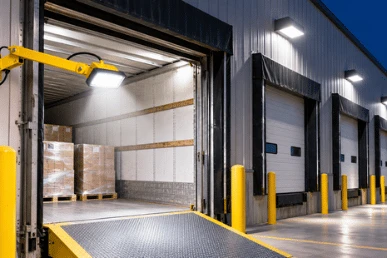
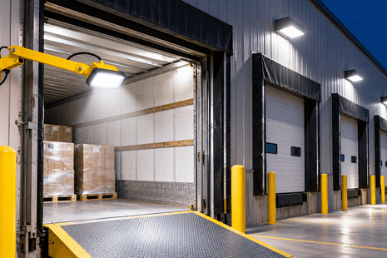
Adjustable loading dock lights are specifically designed to illuminate the interiors of trailers and shipping containers.
These fixtures are commonly installed beside dock doors and feature articulated arms or adjustable mounting systems that allow employees to direct light into parked trailers.
Unlike fixed overhead fixtures, adjustable LED dock lights can be repositioned to accommodate different trailer lengths, loading configurations, and work activities.
Benefits include:
-
Focused illumination inside trailers
-
Adjustable positioning for changing work areas
-
Reduced dependence on portable lighting
-
Durable construction for industrial environments
-
Energy-efficient LED operation
For warehouses with frequent loading and unloading activities, adjustable dock lights are often an essential component of the overall lighting system.
Explore our selection of LED Dock Lights, including options from Westgate Manufacturing and Alphalite.
LED Wall Pack Lights
While adjustable dock lights illuminate trailer interiors, exterior LED wall packs provide lighting around loading dock entrances and surrounding areas.
Wall packs are mounted directly to the building exterior and can illuminate truck approaches, dock doors, pedestrian pathways, and nearby work zones.
Depending on the application, facilities may choose traditional, full-cutoff, or adjustable wall pack fixtures.
For example, the Westgate 150W LED Non-Cutoff Wall Pack is designed for commercial exterior applications, including loading docks. It features 4000K illumination, 0–10V dimming, and an IP65 rating.
Wall packs are especially useful for warehouses operating after dark or facilities requiring consistent exterior visibility.
LED High Bay Lights
High bay lighting provides general illumination throughout warehouses, distribution centers, and industrial buildings with elevated ceilings.
Although high bays aren't a replacement for dedicated trailer dock lights, they play an important supporting role.
Properly positioned high bay fixtures illuminate staging areas where employees prepare shipments, organize pallets, and operate forklifts.
Combining high bay lighting with adjustable dock fixtures helps create a more complete warehouse lighting system.
LED Flood Lights
LED flood lights are another option for exterior loading dock areas.
These fixtures provide broad illumination across truck courts, service roads, and outdoor staging areas.
Flood lighting can be particularly useful for facilities with large exterior loading zones or multiple truck access points.
When selecting LED flood lights, consider beam angle, mounting height, and light distribution to avoid excessive glare or unwanted light spill.
How to Choose the Right LED Loading Dock Lights
Selecting commercial dock lighting requires evaluating several technical and operational factors.
1. Lumens and Brightness
One of the most important specifications to understand is lumen output.
Lumens measure the total amount of visible light produced by a fixture, while watts measure electrical power consumption.
A higher-wattage fixture doesn't necessarily provide better illumination for every application.
For loading dock operations, the goal is to deliver adequate light to the working surface without creating unnecessary glare.
Consider:
-
Trailer dimensions and interior conditions
-
Distance between the fixture and work area
-
Mounting location
-
Beam angle and light distribution
-
Required illumination for specific tasks
A lighting layout or photometric evaluation can help determine the appropriate light levels for the application.
2. Adjustable Arms and Mounting Options
For dedicated trailer lighting, adjustability is especially important.
Loading docks accommodate different trailer sizes and configurations, and workers may need to redirect illumination throughout the loading process.
Common mounting configurations include fixed wall mounts, single-arm adjustable fixtures, and articulated-arm systems.
When comparing options, evaluate the arm's reach, range of movement, mounting requirements, and ability to remain securely positioned during use.
Fixtures should also be installed where they won't interfere with dock doors, vehicles, or material-handling equipment.
3. Color Temperature
Color temperature, measured in Kelvin (K), describes the appearance of light produced by a fixture.
Commercial LED loading dock lights are commonly available in neutral to cool white color temperatures.
4000K: Provides neutral white illumination suitable for many commercial and industrial environments.
5000K: Produces a cooler white appearance frequently used in warehouses, manufacturing facilities, and task-oriented workspaces.
5700K–6000K: Provides a daylight-like appearance and is available in certain dedicated LED dock light fixtures.
For example, Beacon Lighting Supply carries Westgate LED loading dock lights in 5700K and 6000K configurations.
The best color temperature depends on the facility's existing lighting, employee preferences, and task requirements. Higher color temperature doesn't automatically mean greater brightness.
4. Durability and Environmental Protection
Loading docks can expose lighting equipment to vibration, dust, moisture, temperature fluctuations, and accidental impacts.
Choosing durable industrial LED lighting fixtures helps minimize maintenance and premature failures.
Important features may include:
-
Heavy-duty metal housings
-
Impact-resistant lenses or guards
-
Secure mounting hardware
-
Appropriate environmental protection ratings
-
Reliable LED drivers
-
Suitable operating temperature ranges
For outdoor loading dock lighting, verify that fixtures are listed for the intended wet or damp location.
An IP65 rating, for example, indicates dust-tight protection and resistance to water jets under defined testing conditions.
However, not every indoor dock light requires the same environmental protection as an exterior wall pack.
5. Energy Efficiency
Energy efficiency is another major consideration when upgrading warehouse loading dock lighting.
Traditional dock lights may use incandescent or halogen lamps that consume more electricity and generate considerable heat.
Modern LED alternatives generally provide comparable or better usable illumination with lower energy consumption.
Consider a facility replacing 100W traditional dock lights with 36W LED fixtures.
Each fixture would reduce its connected lighting load by 64 watts.
Across 20 dock doors operating 12 hours daily, the reduction would equal approximately 15.36 kWh per day, or 5,606 kWh annually.
Actual savings depend on operating hours, fixture performance, and electricity rates.
For facilities operating around the clock, the potential savings may be even greater.
Common Loading Dock Lighting Mistakes to Avoid
Even high-quality commercial LED fixtures can perform poorly when improperly selected or installed.
Relying exclusively on overhead warehouse lights: General lighting may leave significant shadows inside trailers.
Choosing fixtures based only on wattage: Evaluate lumen output, beam distribution, and task requirements instead.
Ignoring fixture placement: Poor mounting positions can create glare, shadows, or interference with loading equipment.
Overlooking environmental conditions: Fixtures must be suitable for the dust, moisture, temperature, and physical conditions of the installation.
Failing to plan for maintenance: Consider fixture accessibility, mounting hardware, warranty coverage, and replacement availability.
Avoiding these mistakes helps warehouse managers and contractors develop more reliable lighting systems.
LED Loading Dock Lighting for Different Warehouse Applications
Different warehouse operations may require different combinations of fixtures.
Distribution Centers
High-volume distribution centers often operate multiple loading docks simultaneously.
Adjustable LED dock lights can provide focused illumination inside trailers, while high bay lighting supports sorting and staging operations.
Manufacturing Facilities
Manufacturing warehouses may handle oversized materials, specialized equipment, or irregularly shaped shipments.
Durable industrial dock lights with flexible positioning can help accommodate these changing conditions.
Cold Storage Warehouses
Cold storage environments introduce additional challenges, including low temperatures and condensation.
When specifying LED lighting for refrigerated loading areas, verify the fixture's operating temperature range and suitability for the environment.
Freight and Logistics Facilities
Freight terminals frequently operate during nighttime and early morning hours.
A combination of trailer dock lights, exterior wall packs, and truck court lighting can support visibility throughout the facility.
When Should You Upgrade Your Loading Dock Lighting?
An LED lighting upgrade may be worth considering when existing fixtures show signs of declining performance.
Common indicators include:
-
Frequent lamp replacements
-
Inadequate illumination inside trailers
-
Excessive glare or uneven lighting
-
Damaged or difficult-to-position fixtures
-
High lighting-related electricity costs
-
Outdated fixtures requiring significant maintenance
Before replacing existing equipment, evaluate the current layout and identify areas where additional task lighting or improved fixture placement may be needed.
In some cases, upgrading a few strategically located fixtures can improve performance without replacing the entire warehouse lighting system.
Shop LED Loading Dock Lights at Beacon Lighting Supply
Choosing the right LED loading dock lights is an important part of creating an efficient, dependable warehouse lighting system.
From adjustable trailer lights to exterior wall packs and general warehouse illumination, each fixture type serves a specific purpose.
At Beacon Lighting Supply, we provide commercial and industrial lighting solutions for contractors, warehouse operators, facility managers, and property owners.
Our LED Dock Lights category includes products from trusted manufacturers such as Westgate Manufacturing and Alphalite, with options designed for industrial loading dock applications.
Whether you're upgrading outdated dock lights, expanding a distribution center, or sourcing fixtures for a new warehouse project, our team can help you explore lighting solutions that fit your operational requirements.
Shop LED Loading Dock Lights or visit Beacon Lighting Supply to explore commercial lighting solutions for your next project.