
Beacon Lighting Supply | Lighting the Way
Dimming Systems: 0-10V vs. Triac vs. DALI
Lighting has evolved far beyond the days of simple on/off switches. Today’s dimming systems allow us to create flexible, energy-efficient, and comfortable environments for homes, offices, retail spaces, and industrial facilities. But not all dimming systems are created equal - and choosing the wrong one can lead to flickering lights, poor performance, or compatibility issues.
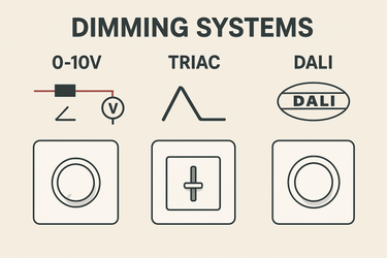
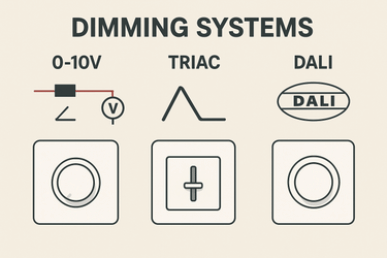
Three of the most common dimming systems you’ll encounter are 0-10V, Triac (phase-cut), and DALI (Digital Addressable Lighting Interface). Each has its strengths, limitations, and ideal applications. In this guide, we’ll break down how they work, where they’re used, and how to decide which is best for your project.
Why Dimming Systems Matter
Before diving into the details, it’s important to understand why dimming matters:
-
Energy savings: Lights at 50% brightness consume less energy, lowering costs.
-
Customization: Different spaces (offices, classrooms, restaurants) benefit from different lighting moods.
-
Comfort & well-being: Adjustable lighting supports productivity, relaxation, and even circadian health.
-
Longevity: Running LEDs at lower output reduces heat and extends lifespan.
The right dimming system makes these benefits possible.
1. 0-10V Dimming (a.k.a Low Voltage Dimming)
How It Works
0-10V dimming is one of the oldest and simplest dimming control methods. It uses a low-voltage signal (0 to 10 volts DC) to adjust light output:
-
10V = 100% light output
-
0V = minimum dim level (not always off)
Advantages
-
Widely used and reliable in commercial and industrial applications.
-
Smooth dimming without noticeable flicker.
-
Simple wiring: usually two additional control wires (purple + gray).
-
Works well with LED drivers designed for 0-10V control.
-
Industry standards are moving towards fixture integrated sensors that use smart app bluetooth control options, such as dimming, grouping, and occupancy sensing.
Limitations
-
May require extra wiring separate from power wiring.
-
Control is analog, so it doesn’t provide advanced features like feedback or programming.
-
Minimum dimming level often stays around 5-10% (not true “off”).
Best For
-
Warehouses, offices, schools, and retail spaces.
-
Applications where consistent dimming is needed but advanced controls aren’t.
2. Triac Dimming (Phase-Cut Dimming)
How It Works
Triac dimming - also called forward-phase or leading-edge dimming - is common in residential applications. It works by cutting portions of the AC waveform to reduce power to the light source, dimming its brightness. A more advanced version, ELV (Electronic Low Voltage) dimming, uses reverse-phase cutting.
Advantages
-
Works with standard wall dimmers (often already installed in homes).
-
Cost-effective and simple to set up - no extra wires required.
-
Compatible with many retrofit LED bulbs designed for household use.
Limitations
-
Compatibility can be tricky - not all LED drivers work well with Triac dimming.
-
May cause flicker, buzzing, or reduced dimming range with LEDs.
-
Less efficient at very low dim levels compared to other systems.
Best For
-
Residential lighting and small commercial projects.
-
Retrofit applications where you want to use existing wiring and dimmer switches.
3. DALI (Digital Addressable Lighting Interface)
How It Works
DALI is a digital communication protocol for lighting control. Unlike analog systems, it allows two-way communication between controllers and fixtures. Each light (or group of lights) has its own unique address, enabling individual programming and control.
Advantages
-
Highly flexible and scalable - great for large buildings.
-
Two-way communication: fixtures can report status, errors, and energy usage.
-
Precise control: adjust individual fixtures, groups, or entire zones.
-
Integration with building automation systems (HVAC, shading, etc.).
-
Standardized protocol supported by multiple manufacturers.
Limitations
-
Higher upfront cost compared to 0-10V or Triac.
-
Requires programming and commissioning, which may need a trained technician.
-
More complex installation than simple analog systems.
Best For
-
Large commercial buildings, offices, hospitals, and airports.
-
Smart building projects requiring advanced automation, reporting, and flexibility.
Comparing 0-10V, Triac, and DALI
|
Feature |
0-10V |
Triac |
DALI |
|
Control Type |
Analog (voltage signal) |
AC phase-cut |
Digital (two-way) |
|
Wiring |
Requires extra low-voltage wires |
Uses existing line voltage wiring |
Control bus (2 wires, polarity-free) |
|
Cost |
Moderate |
Low |
Higher |
|
Dimming Range |
~10-100% |
Varies; may cause flicker at low levels |
1-100% with precision |
|
Scalability |
Limited |
Very limited |
Very high |
|
Ideal Use |
Commercial/industrial |
Residential/retrofit |
Large smart buildings |
Choosing the Right Dimming System
When deciding between these systems, consider the following factors:
Project Type
-
Residential retrofit → Triac
-
Basic commercial dimming → 0-10V
-
Smart building or large facility → DALI
Budget
-
Triac is cheapest upfront.
-
0-10V adds wiring costs but remains affordable.
-
DALI requires the largest investment but delivers the most long-term value.
Performance Needs
-
For smooth, consistent dimming with LEDs → 0-10V or DALI.
-
For granular control, automation, and reporting → DALI.
-
For simplicity and familiarity → Triac.

Final Thoughts
Dimming technology is no longer one-size-fits-all. The right choice depends on your project’s size, budget, and performance requirements:
-
Triac dimming works best in homes and simple retrofits.
-
0-10V dimming is a reliable workhorse for many commercial spaces.
-
DALI systems shine in complex buildings where flexibility, control, and data are essential.
As lighting technology continues to evolve, expect more integration with IoT and smart building systems, with DALI and digital protocols paving the way. But by understanding the core differences between 0-10V, Triac, and DALI, you’ll be well equipped to choose the system that keeps your spaces efficient, comfortable, and future-ready.